.svg)


For the first few minutes after a cart abandonment, your retargeting ads usually can’t reach the shopper. An instant message or a call can. What happens next depends on whether the two systems talk to each other.
Picture a shopper who fills her cart and gets as far as checkout. Then she closes the tab, and you have no idea why.
Two minutes later, a text asks whether anything stopped her. She replies that shipping looked high. The answer points her to the free-shipping threshold she was only a few dollars away from, and she checks out.
Then the waste begins. For the next few days, your retargeting ads keep chasing a customer who has already paid you.
Here’s why that happens. Your conversation stack and your media stack work on the same person, on the same clock, yet they rarely share data or budget. Neither one knows what the shopper already told the other. We think of it as one shopper, two recovery systems.
Most cart recovery advice handles timing with the “Act fast” rule. That rule usually relies on a famous statistic that was never about carts, so we’ll start there.
Then we’ll go through what really happens minute by minute, from both sides. Which channels can act when, what a recovered cart costs, how to hand a shopper from conversation to paid media, and how to measure it honestly.
What the “Act Fast” Rule Actually Proves
The “act fast” rule proves that quick phone follow-up raises your odds of reaching and qualifying a web lead. It says nothing about recovering carts, because the research behind it never looked at carts.
Where the speed-to-lead statistic really comes from
The famous statistic comes from an MIT Lead Response Management study. You’re probably familiar with the line, “Call a lead within five minutes, and you’re 21 times more likely to qualify them.”
The study used InsideSales.com data, analyzed by Dr. James Oldroyd, who was then at MIT Sloan. The team studied three years of data from six companies, covering more than 15,000 web leads and over 100,000 call attempts. The headline finding was blunt. Wait 30 minutes instead of five, and your odds of qualifying the lead drop 21 times.
Almost nobody repeats the next detail. The study says outright that it did not address close ratios. “Qualify” meant the lead agreed to enter a sales process, such as booking an appointment. The famous stat measures contact and qualification. It doesn’t measure purchases.
Then a Harvard Business Review article by Oldroyd, Kristina McElheran and David Elkington followed up with a much bigger dataset: 1.25 million leads from 29 B2C and 13 B2B companies in the US. Firms that called within an hour were nearly seven times as likely to qualify the lead as firms that waited even an hour longer.
Once again, “qualify” meant a meaningful conversation with a decision maker, not a sale.
Why a cart abandoner isn’t a sales lead
A cart abandoner isn’t a sales lead because she has already decided what she wants. Both studies tracked people who filled in a form and waited for a call. She’s much further along. She has chosen a product and started to pay, so there’s no qualification step left to win.
What stops a shopper from buying is often a small and specific issue. In Baymard Institute’s survey of US shoppers, 42% had abandoned a cart because they were just browsing. Set that group aside, and 40% of the rest left because of extra costs like shipping and taxes. Others pointed to slow delivery, a site they didn’t trust, a declined card, or a checkout that forced them to create an account.

However, Outcraft’s conversations with real customers capture something different: a real shopper sometimes abandons their cart because they have some questions about the product and aren’t ready to buy until they get clear answers.
Either way, one clear reply can solve most of those deals.
That leads to our replacement premise. Speed can grab a customer before their intent fades. For carts, another reason that gets far less attention is that the cost of recovery climbs as time passes. In the first minutes, winning her back costs you a message. Later, it costs you an auction.
You can see that on your own account. For each day after abandonment, calculate:
Cost per recovered cart on day N = (CPM ÷ 1,000 × impressions served on day N) ÷ orders recovered on day N
The price of an impression doesn’t change much because she abandoned her cart a day earlier. The denominator does: each day, fewer abandoners come back and buy, so the same spend recovers fewer orders. Run this for days 0–7, set day 0 to 100, and you’ll see your own cost curve.
The Blind Window: Two Timelines, One Shopper
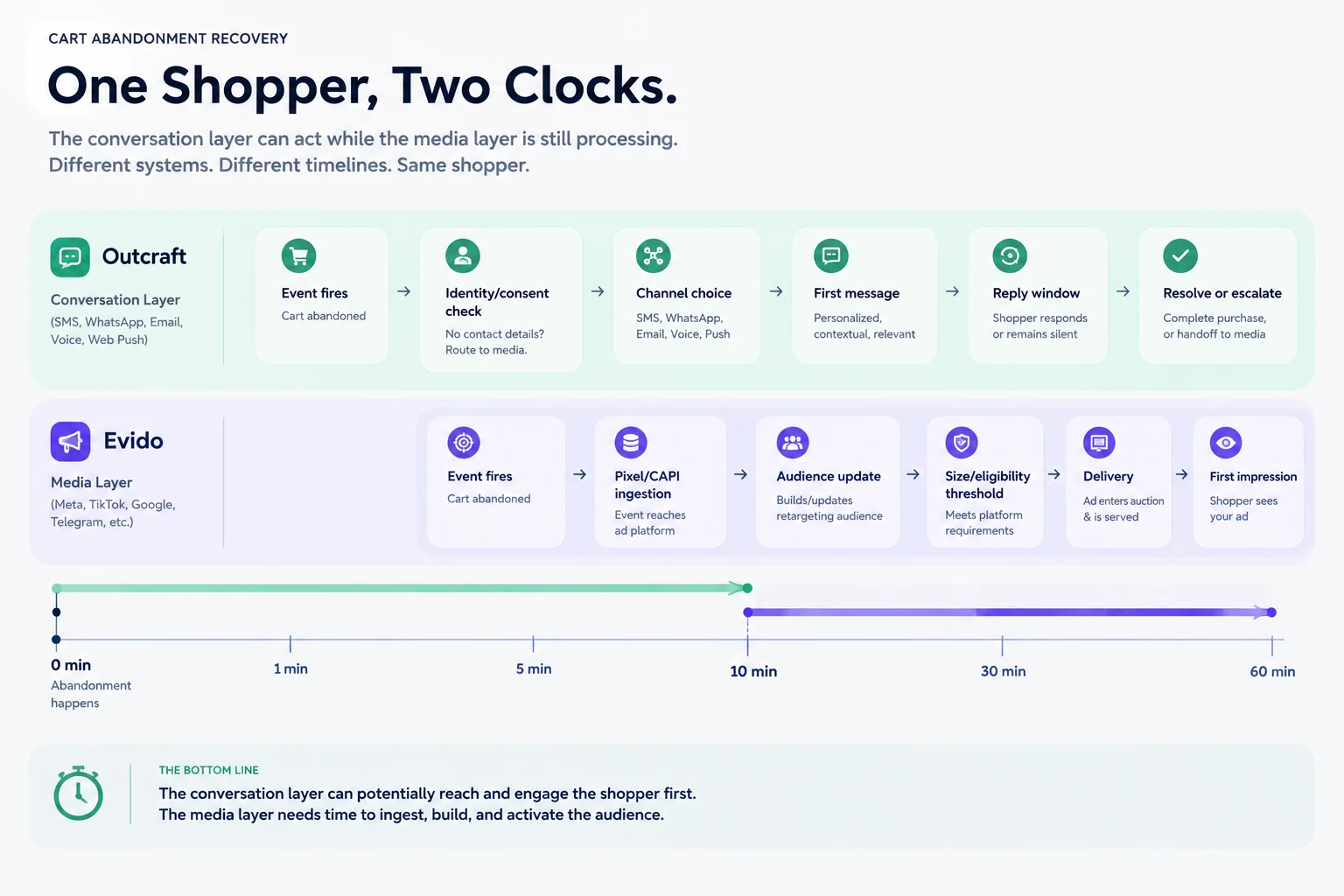
The Blind Window is the short period right after cart abandonment when your conversation layer can already reach a shopper, but not your paid retargeting sequence. On paper, it can close within minutes. In practice, it stays open until she next opens an app where your ad can win an auction. Inside it, a message is the only thing that moves.
However, the conversation layer can only reach shoppers it can identify. That means, you can reach someone who left a phone number or email at checkout and agreed to hear from you. According to Outcraft, cart abandoners have around a 35% call pickup rate if contacted within the first 10 minutes.
An anonymous shopper who added to cart and vanished is a different case. You have no way to message her, so paid media is her only route back from the very first second. The Blind Window applies to identified shoppers, and that’s exactly where the two systems overlap and start paying twice.
The conversation track also takes some time however small the window is. The system has to match the shopper to a contact record, check consent, pick a channel, and load an approved template before sending the first message.
Including all those checks, the typical time from abandonment event to first message sent is around 10 minutes, even though the channel itself can deliver in a couple of minutes. The difference is that this lag is short and within your control. The media track’s lag mostly isn’t.
Why “real-time retargeting” isn’t real time
Real-time retargeting isn’t real time because a pixel event isn’t an audience. The pixel fires the moment a shopper leaves. Before an ad can reach her, she has to be matched, added to an audience, qualify, and then win an auction while she’s actually on the platform.
It helps to separate two situations that platform documentation often blurs. The first is building a new audience. Here the platforms publish timelines. Meta notes that a newly created website custom audience takes around 24 hours to start collecting data, though Meta says audiences then update automatically as people reach tagged pages.
Google says new lists can take 48 to 72 hours to fully populate, and it won’t show ads to a segment until it has at least 100 active users. TikTok needs 1,000 matched users before you can target a custom audience.
The second situation is the one that matters for cart recovery. A new abandoner joins an audience list that already exists and is already being targeted for recovery. Only some platforms publish how long that takes. This gap is retargeting audience latency, and it’s what sets the length of the Blind Window.
Meta says a new website-audience member is eligible for ads “in a matter of minutes.” Google says visitors join data segments “within seconds.” X adds people to a website activity audience as soon as they meet its URL rules, but recommends waiting at least a week after installing the tag before running campaigns. Pinterest only says the audience size shown in Ads Manager updates “within 24 hours.” LinkedIn, TikTok and Snapchat don’t publish a figure for website audiences, and LinkedIn won’t serve a retargeting segment until it reaches 300 members. None of them promises when the first impression will actually serve.
Telegram works differently. Its official ad platform lets you pick the channels where ads appear, and Telegram says it doesn’t use private chats or contact lists for targeting. It does offer a Pixel Tag that records site events like Add to Cart and Purchase, but only to track conversions from your Telegram ads. The data is processed anonymously and in aggregate, so it can’t identify individual users or become an audience. You can’t build a “cart abandoners” list and target it, so classic pixel-based cart retargeting isn’t its model.
“Everyone asks for real-time retargeting, but the pixel firing is only the first step. She still has to land in the audience, be eligible, and then actually open an app where your ad can win. Until then, the ad account can’t do anything for that cart. A message can.”
— Natalia Globa, Performance Marketing Manager at Evido by Aitarget
What Can Actually Reach a Shopper Inside the Blind Window?
Inside the Blind Window, only direct channels can reach a shopper: SMS, email, WhatsApp, voice, and on-site or web push. How fast each one lands, and whether it can be used at all, depends on the channel and on the consent and setup you have in place before she ever abandons.
| Channel | Realistic first-touch latency | Best role inside the window |
|---|---|---|
| SMS | 2 minutes | Opens a two-way question: “Did anything stop you?” |
| 5 minutes | Carries the full cart. A backup, not the fastest answer. | |
| Voice | 5 minutes | High-value carts, or escalation after silence. A missed call can end in a voicemail plus an SMS saying who called. |
| 10 minutes | A strong first touch for non-US shoppers. Free-form replies once she answers. | |
| On-site / web push | Instant while she’s on site; push only if she opted in | Catches hesitation before she leaves. |
Table 1: Channel capability inside the Blind Window. (Source: Outcraft.)
Every row except the last assumes she left contact details at checkout. Without them, the conversation layer has nobody to talk to.
The WhatsApp template problem that many marketers overlook
WhatsApp classifies cart reminders as marketing messages. Meta’s template guidelines list “You left items in your cart” as marketing, even when the user asked for the reminder. This is where a lot of cart flows quietly break.
US brands face a bigger problem. WhatsApp doesn’t currently deliver marketing templates to US phone numbers, and those sends return an error. A WhatsApp cart flow that works beautifully in Madrid may never reach a shopper in Miami. For US shoppers, SMS and email do the heavy lifting.
The conversation itself is the only door that stays open. You get a 24-hour customer service window starting from the time a shopper messages you, and you can reply freely inside it. One thing to keep in mind here is that Meta revises WhatsApp pricing from time to time, service messages included, so check the current pricing before you model costs.
A Recovery Ladder, Not a 1-Hour / 24-Hour / 72-Hour Schedule
A recovery ladder acts on what the shopper actually does, while a fixed schedule sends the same sequence to everyone. Shoppers don’t behave the same way. Some reply and some go quiet. Some say no, and a few come back and buy before you’ve sent anything.
What to do when the shopper replies, says no, or buys?
If the shopper replies, answer the exact objection she named. If she says no, stop contacting her everywhere. If she buys on her own, stop everything too, ads included.
A reply usually points to one fix. You can either explain the free-shipping threshold, or confirm the delivery date. You can also offer another payment method, or point her to the returns policy. If the problem is payment, taking it inside the conversation, on a call or through a payment link, saves her a trip back to the checkout she just abandoned.
Don’t offer discounts right at the beginning, rather keep it as last resort. In Outcraft’s cart recovery calls, many price objections resolve once the voice AI agent explains the product’s value, with no discount at all. A coupon costs you money for a problem one clear answer could have fixed.
A “no” calls for the opposite move. Stop your message flows and your ads at the same time. Every impression served after “no thanks” is money spent on a closed door, and it’s the branch almost every drip sequence ignores.
When the shopper goes silent
Consider switching communication channels instead of repeating the same one when a shopper goes silent. You can try email or a call if a text goes unanswered after 10 minutes given she’s consented to one. Outcraft’s sequences follow this pattern when reaching a potential customer. It sends a message first, then a call, and if she doesn’t pick up, a short voicemail plus an SMS explaining who called and why.
Repetition has its own cost. The MIT Lead Response Management study found that after 20 hours, every extra call attempt was linked to lower odds of reaching the lead. The authors themselves weren’t sure whether the calls caused it. That finding came from phone leads rather than carts, but the lesson travels well.
You also need to set a boundary. Decide on a maximum number of touches before conversational recovery stops, and the shopper is handed to media or left alone.
Match the effort to the cart, too. In Outcraft’s experience, voice earns its cost on higher-value orders of roughly $100 and up, while low-ticket impulse buys under about $30 are better left to email and SMS. Complex or very high-value carts can go to a person. AI agents earn the first reply; people close the tricky cases.
“The first reply tells you more than any dashboard. A shopper who says shipping looked high just handed you a fix for her cart and a brief for your next ad. Our job is to ask the question before the auction starts.”
— Will Nauseda, CEO at Outcraft AI
What Does a Recovered Cart Actually Cost?
A recovered cart costs whatever you spent on that recovery path, divided by the orders the path actually added. Most recovery dashboards show a recovery rate instead, and that number hides the cost. To compare conversation and media fairly, calculate cost per recovered cart the same way for both.
| Conversation path | Media path | |
|---|---|---|
| What you pay for | Per-message or per-conversation fees, platform costs, and agent time where people handle calls | Impressions (CPM) or clicks, plus creative production |
| Cost per recovered cart | (Cost per touch × touches sent + platform and agent costs) ÷ incremental orders recovered | (CPM ÷ 1,000 × impressions served + creative costs) ÷ incremental orders recovered |
| Inputs you need | Rate per channel and country, touches per shopper, orders recovered, and a no-touch holdout group | CPM, frequency, days since abandonment, and a no-touch holdout group |
| Main risk | Over-messaging, consent breaches, and discounting shoppers who’d have come back anyway | Paying for buyers who’d convert anyway, plus exclusion lag |
Table 2: Conversation vs. media recovery economics. (Source: Outcraft and Evido by Aitarget.)
Do the calculation using your own numbers. Don’t use anyone’s benchmark, ours included. Message rates vary by channel and country. CPMs swing with the account and the season. Only your data will give you an accurate estimation.
The Handoff: Suppress, Learn, Then Re-route
The handoff is the moment the conversation layer either pulls a shopper out of paid media or passes her over with what it learned. The selection depends on how the conversation ended.
When the shopper converts, suppress the retargeting
Once a shopper buys, or says no, get her out of every retargeting audience list as fast as you can. This is called cart recovery suppression, and most stacks do it more slowly than you think. Meta’s own documentation says audience add/remove updates “can take a few hours.” On Google, a visitor stays in a segment until their membership duration expires, so a purchase doesn’t remove her from your cart list. Only a separate purchasers exclusion does.
You can estimate the leak with this simple formula: recovered shoppers still in audiences × impressions each sees before exclusion × CPM ÷ 1,000.
When the shopper doesn’t convert, hand the objection to creative
If the conversation doesn’t close the sale, the reason she gave is the most valuable thing it produced. Send it to your media team as a creative brief. Instead of a generic “come back” ad, your retargeting can answer the objections abandoners actually raise.
Do this in aggregate, not shopper by shopper. Splitting abandoners into audiences by what each person said usually produces segments too small to target, for the audience-size reasons covered above. Using what a shopper said in a private conversation to target her with ads also raises consent questions your legal team would need to clear.
The safer approach is to list down stated reasons across all abandoners, then let that mix decide which creative ad runs to your whole abandoner audience. If shipping cost tops the list this month, free-shipping ads get the most weight.
Here’s how we’d route the common objections.
| Shopper objection | Conversational response | Creative implication (for whole abandoner audience) | What not to do |
|---|---|---|---|
| Shipping cost too high (25%) | Explain the free-shipping threshold or the real delivery cost | Free-shipping-threshold ad | Don’t jump straight to a sitewide discount |
| Wanted to compare (20%) | Answer spec questions or offer a quick comparison | Comparison or social-proof ad | Don’t flood her with urgency |
| Delivery too slow (5%) | Confirm real delivery dates or faster options | Delivery-promise ad | Don’t promise dates you can’t hit |
| Didn’t trust the site (5%) | Point to reviews and the returns policy | Trust and returns-policy ad | Don’t make trust claims you can’t back up |
| Payment failed (5%) | Offer another payment method, or take payment in the conversation | None (Keep it out of ads and handle it in messaging) | Don’t reference a failed payment in an ad |
| Just browsing (40%) | Offer to save the cart, with no pressure | A light reminder, or suppression | Don’t escalate channels |
Table 3: Objection → next action. Source: Outcraft (conversation) and Evido by Aitarget (creative).
What a recovery ad can and can’t say
Every platform has its own set of rules when it comes to recovery ads. For example, Meta’s advertising standards ban ads that assert or imply personal attributes, and vulnerable financial status is on that protected list. That’s one more reason to keep failed payments out of ads altogether.
Copy like “Hey Sarah, still thinking?” instantly tells her you’ve been watching, which is risky in review and off-putting in her feed.
Our suggestion: The ad should make sense to anyone in the audience, not just to the person whose cart triggered it.
Your 10-Minute Playbook Is Not Portable
A cart recovery playbook is not the one ring to rule them all. A playbook built for US and European shoppers doesn’t transfer cleanly to other regions. Expand into the CIS, MENA, or South Asia, and the email-first assumption behind most templates starts to crack. Across Evido’s portfolio, the strongest WhatsApp markets are Kazakhstan, Azerbaijan, the UAE and wider GCC, and Kenya, which is effectively WhatsApp-first. There, a WhatsApp opener often beats email as the first touch. In Uzbekistan, Telegram plays that role: shoppers already order through brand bots and channels, so the bot doubles as the recovery thread.
The conversation half needs a local check to be market-fit. Like, channel fit varies by market, and WhatsApp pricing depends on the shopper’s country code.
The media half shifts as well. Telegram places ads by channel context rather than pixel audiences, so the Blind Window works differently where Telegram carries most of the reach.
Measure Cart Recovery Without Lying to Yourself
You need to count each order once and compare your results against shoppers you never contacted to get a real cart recovery measurement. Both halves of that sentence are harder than they sound.
The double-count problem
The double-count problem happens when your messaging platform and your ad platform both take credit for the same order. It’s built into the defaults. Meta credits ads for purchases within seven days of a click or one day of a view.
Now picture one shopper. She taps your SMS link and leaves without buying. The next morning she sees your ad, then checks out. Your CRM and your ad account each log a recovered order. Your bank logs one payment.
Another issue is that the same thing happens inside your targeted channels. If one abandonment event triggers an email flow in one tool and an SMS or call in another, each tool may count the order as its own.
The recovered revenue will look bigger than it really is when you bring the data from all channels in one dashboard. Neither platform is lying. Each one answers “did I touch this order?” when the real question is “did I cause it?”
Avoiding this is absolutely vital. What you can do is compare the recovered orders each tool reports against the deduplicated count in your order system: overstatement = (sum of claimed orders − deduplicated orders) ÷ deduplicated orders.
Design a holdout
A holdout tells you what each stack actually caused. It works on the same logic as a platform lift study: compare people who were exposed against people who weren’t. Randomly assign abandoners, at the moment they abandon, into four groups:
- No touch: no messages and no retargeting. This is your baseline for shoppers who come back on their own.
- Conversation only: messages, with the shopper excluded from retargeting audiences.
- Media only: retargeting, with no recovery messages.
- Both: your current setup, as business as usual.
Each group’s recovered orders minus the no-touch group’s gives you incremental orders. Comparing the single-stack groups with “both” shows whether running them together adds orders or just adds spend.
Two cautions:
- The exclusions that separate the groups have their own lag, so check that shoppers really stay in their assigned group.
- Smaller brands may need to run the test longer to collect enough orders for a reliable read.
Once it’s done, report only the incremental recovered orders and blended cost per recovered cart across both stacks, measured against the holdout to your CMO.
The 10-Minute Cart Recovery Audit
Here is a 10-minute audit checklist to be sure whether your stack can act inside the Blind Window and hand off cleanly once it closes. Screenshot it and run it against your setup this week.
- Your first touch fires within minutes of abandonment, on a channel the shopper consented to.
- Anonymous cart abandoners with no contact details go straight to paid media.
- Your WhatsApp cart templates are categorized correctly, and US numbers route to SMS or email instead.
- You know how long each ad platform takes to make a new abandoner reachable in an existing audience.
- Your flow branches on reply, silence, refusal, and purchase, not just on time, and the ladder has a cap.
- A “no” suppresses the shopper across messages and ads.
- Recovered buyers leave retargeting audience list fast, and you’ve estimated what the exclusion lag costs.
- Aggregated objections feed your retargeting creative, and payment failures stay out of ads.
- You create reports on incremental recovered orders and blended cost per recovered cart, backed by a holdout.
That’s what conversation-first cart recovery looks like in practice. Talk first and suppress fast. Then hand paid media only the handful of leads that the conversation couldn’t close, along with what it learned.
If you want help with either half, here’s how the work splits. Outcraft owns the conversation layer. Its AI sales agents reach shoppers inside the Blind Window across SMS, email, WhatsApp, and voice, in 40+ languages, answer the objection that stopped the order, and can take payment on the call.
Evido by Aitarget owns the media and account layer: audience activation, suppression, recovery creative that respects what the shopper already told you, and the ad accounts underneath it all.

.jpg)