.svg)

_converted.webp)
A ChatGPT ad consists of a title of up to 50 characters, copy of up to 100 characters, an image of at least 640×640 px, and a landing page link. The brand name and logo are pulled from your account settings.
Below are all the requirements, the rules for product ads, and a checklist to run through before you submit ads for review.
What an ad is made of
Ads appear below ChatGPT responses. Some elements are set once per account, and others are set for each ad.
A Sponsored label appears next to the brand name.
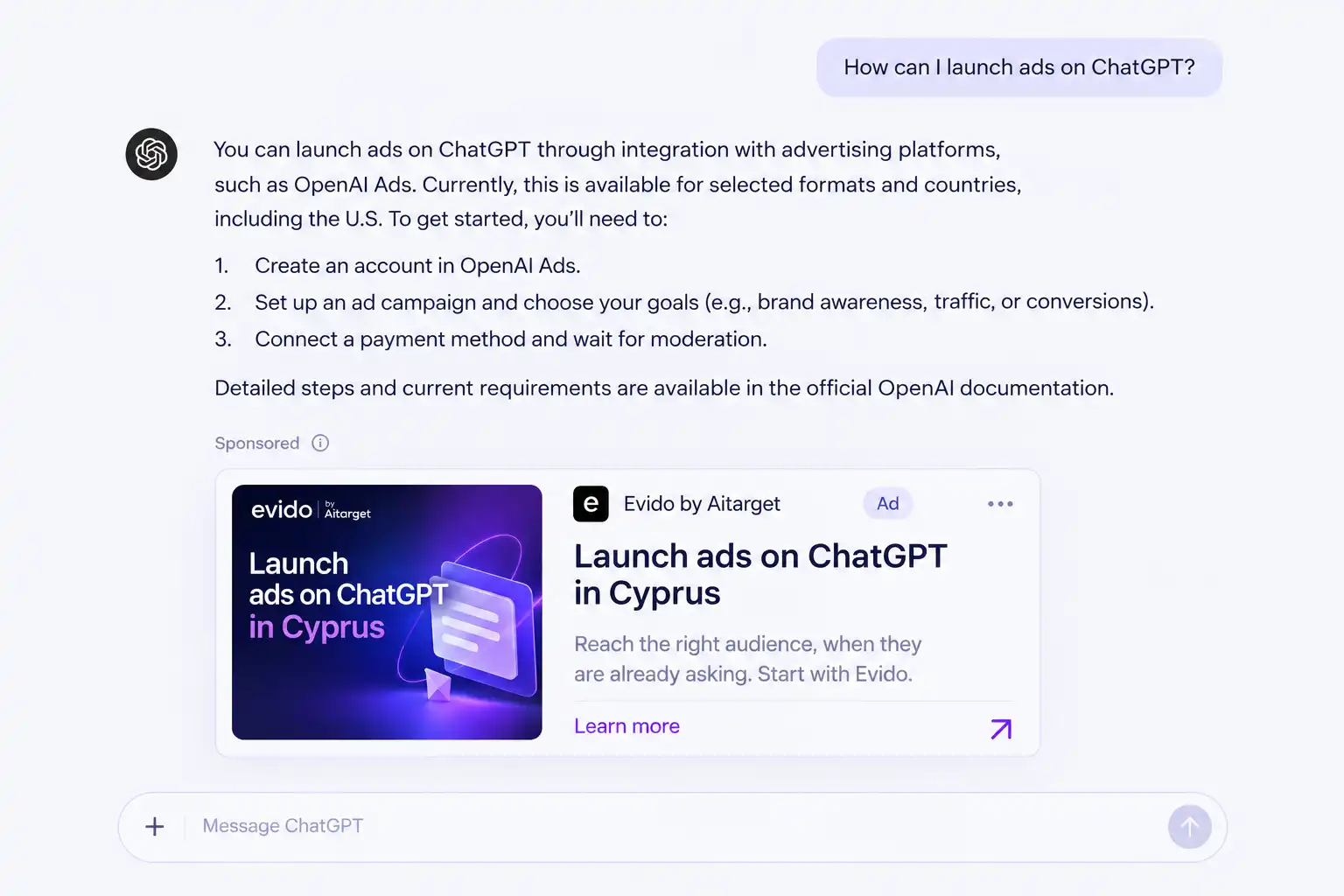
Ad drafts from your website
If a campaign doesn't have enough ads, you may see an "Add new ad" button in Ads Manager. It builds a draft from your website's metadata: an image, a title, and a description. You'll need to review and edit the draft: AI doesn't generate new copy or images.
How to write the title and copy
There are 3 rules for ad copy.
- The title makes the value clear right away: what the product offers or why it's useful. A specific detail works better than generic marketing language.
- The copy adds something new instead of repeating the title: a benefit, a feature, or a use case. Ideally, it makes clear who the product helps and when.
- Each variation takes its own angle. OpenAI recommends many ads per offer, and each one should differ in meaning, not just wording.
Example for a sales tracking tool:
The weak version could fit any product, so the system has nothing to match it with in a conversation. The strong version names the task and the result.
Three angles for one offer:
- Feature: "POS and marketplace reconciliation without Excel" (48 characters);
- Use case: "Closing the month? One report for every channel" (47);
- Audience: "Inventory tracking for multi-store retailers" (44).
Example for a tour operator: title "Georgia tours in May: flights and hotel included" (48), copy "Ready-made 5–7 day itineraries with a guide. We'll match dates to your vacation." (80).
Write the way someone would describe their task in ChatGPT. The ad appears below an answer to a specific question, and an advertising slogan next to it feels out of place. We cover how ad copy works together with context hints in this article.
Image
The image appears as a small preview. So:
- show one object or one scene, no collages;
- avoid small text, since it won't be readable in the preview;
- make sure the image matches the ad's message;
- avoid anything that looks like the ChatGPT or OpenAI interface: the policies explicitly prohibit this.
Landing page
The landing page is reviewed together with the ad, and the requirements are stricter than they may seem.
- Link to the most relevant page: a product, category, or article page rather than the homepage.
- Don't block OpenAI crawlers. Your site must allow the OAI-AdsBot and OAI-SearchBot user agents. Check robots.txt, bot protection, and geo-blocking: if the crawler can't open the page, the ad won't pass review.
- The link must work and lead to a page that matches the ad.
- The landing page must be reviewable by automated systems. Pages that OpenAI's systems can't review aren't eligible to run.
You can add UTM tags to each ad's link. To check them in ChatGPT's in-app browser on iOS, copy the full link via Share, since the address bar only shows the domain.
Product ads
Online stores can run campaigns based on a product feed. Ads are built automatically from your catalog, and products can appear as a carousel of cards.
Here's how it works:
- Feed. The catalog is uploaded as a CSV file via SFTP. An account can have up to 10 feeds. Required fields include the product ID, title, description, link, brand, image, price with currency, availability, seller, return policy, and target countries.
- Product set. Within an ad group, you can filter products by brand, category, price, rating, and other fields.
- Ad template. Each ad group gets one template ad with the macros
{{brand}},{{product.title}},{{product.body}}, and{{product.price}}. The template title is also 3 to 50 characters, for example{{brand}}: {{product.title}}.
Product links and images must be public and served over HTTPS. Products without an image or with a broken image are excluded from delivery. Location targeting in product campaigns works only at the country level.
Prices and availability can be updated via the API without re-uploading the entire catalog. New products are added with a new feed upload.
What won't pass review
The ad, image, and landing page are reviewed together, mostly by automated systems with human oversight. Ads continue to be monitored after approval. An ad will be rejected if it contains:
- Unsubstantiated claims about product capabilities, pricing, outcomes, affiliations, or comparisons with competitors, as well as exaggerated results and fake endorsements.
- Unprofessional language, including in product and brand names.
- Imitation of the ChatGPT or OpenAI interface, whether its appearance, functionality, or voice.
- A mismatch between the ad and the landing page. An approved creative can't link to a page with prohibited content.
- Prohibited categories: gambling, dating and adult content, alcohol and tobacco, politics, and other topics listed in OpenAI's ad policies.
Any change to the creative creates a new version of the ad and sends it for review again.
Pre-review checklist
- The title is 3 to 50 characters, and the copy is up to 100.
- The title explains the value, and the copy adds new information.
- The copy contains no claims you can't back up.
- The image is at least 640×640 px, readable in a small preview, and doesn't resemble the ChatGPT interface.
- The link leads to a relevant page rather than the homepage.
- Your site allows OAI-AdsBot and OAI-SearchBot.
- Your Brand Name and logo are filled in and approved in the account.
- Each ad group has several variations with different angles.
What's next
People read a ChatGPT ad right after the answer to their question. The copy that wins is the one that continues that answer rather than interrupting it.
If you want to try ChatGPT Ads, submit a request on our website and we'll help you to launch your ad.

.jpg)
_converted.webp)
_converted.webp)