Picture a busy shop on a Lagos street. Hundreds of people walk in, look around, and leave. A handful reach the counter and pay.
Femi, Growth and Influencer Marketing at Velitron, used this picture to describe app installs at "Beyond the Installs," a webinar for banks and fintechs that Evido by Aitarget hosted with TikTok's Sub-Saharan Africa team and Velitron in November 2026. An install is someone walking in. A lender earns money only when that person borrows and pays back.
Yet cost per install is still the headline number in many fintech campaign reports in Kenya and Nigeria. This article collects what the speakers shared on moving past it: which events to optimize for, what tracking TikTok needs to see them, how brand campaigns lower acquisition costs, how to work with FinTok creators, and which licenses you need before the first ad goes live.
What "beyond the install" means for a lender
Ad platforms deliver what you ask for. If a campaign optimizes for cheap installs, the algorithm finds people who will download anything. Many of them never finish KYC, never apply, and never take a second loan.
Nigeria makes this gap wider. The fintech market is crowded, users keep several finance apps on their phones, and switching costs nothing. As Femi put it, getting the download is the easy part; keeping the customer is the hard part.
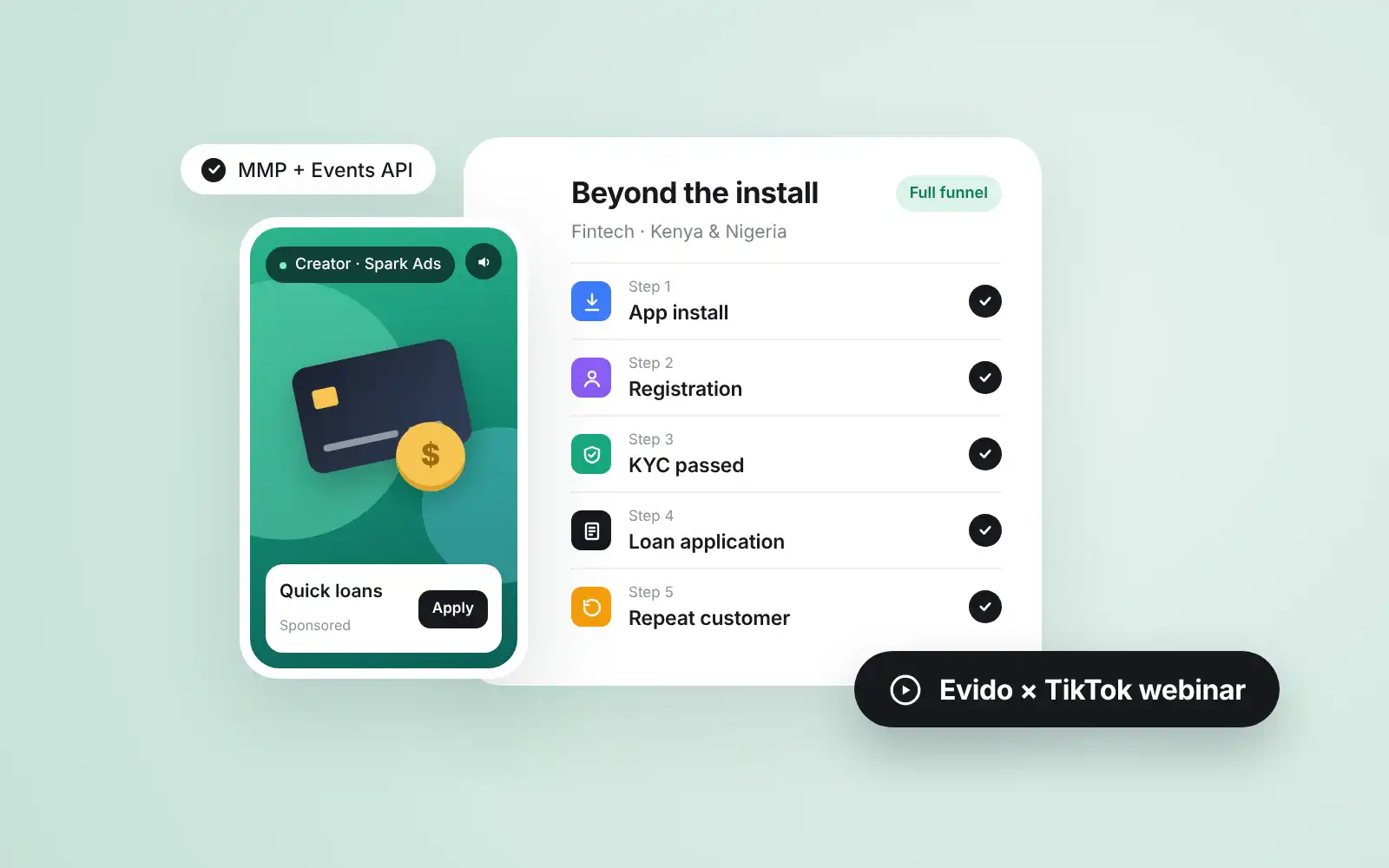
Between the install and the revenue sits a chain of events, and users drop out at every step:
Femi's rule was to optimize for business value. Each event deeper in the funnel costs more per conversion than an install, and that worries some marketers. The extra cost buys users who become customers, and a borrower who repays and returns is worth many cheap installs.
In practice, the deeper the event, the fewer conversions it produces, and the algorithm needs enough of them to learn. A sensible path is to start with the deepest event that still gives a steady flow of conversions, such as KYC completed, and move further down as volume grows.
TikTok's framework for financial services marketing
Zethu Mthethwa, Head of Sales for Sub-Saharan Africa at TikTok, opened the TikTok part of the session with the framework the platform uses with banks and fintechs. Most financial advertisers measure only the lower funnel: installs, applications, leads. Zethu's argument was that the stages above and after it make those lower-funnel results stronger.
The framework has three stages:
- Equity. Build awareness, trust, and cultural relevance through tentpole moments, product launches, and always-on brand activity.
- Acquire customers. Turn attention into app and account sign-ups, online forms, trials, cards, and wallets.
- Increase customer value. Use the signals you already hold on existing customers to cross-sell credit cards, insurance, loans, investments, and rewards.
The logic is sequential. People who already know and trust a brand convert more readily when the acquisition ad arrives. Growth from existing customers means the brand does not have to keep paying more to acquire new ones.
Results from financial brands in the region, as presented in the TikTok deck:
Most of these cases come from South Africa. TikTok has been active with advertisers in Kenya and Nigeria for almost two years, so local benchmarks are still building up.
The tracking setup TikTok needs: Pixel, Events API, and MMP
Optimizing past the install only works if TikTok can see what happens after it. Zethu called infrastructure the backbone of financial campaigns. Good tracking does three things: it helps the algorithm find in-market users, it shows when a user is most likely to convert, and it ties campaigns to business outcomes such as loan applications and opened accounts.
TikTok names three pieces:
Many financial advertisers start with the pixel alone. It covers the website, while app journeys, where most registrations and loan applications happen, stay invisible to the platform. Zethu also pointed to attribution: TikTok often starts the discovery, but when the journey breaks between platforms, that contribution goes unrecorded.
According to TikTok Marketing Science South Africa, combining the Events API with the pixel increased tracked events by 19% and improved CPA by 15%. Enabling advanced matching lowered CPA by 37% and lifted conversion rate by 103%. These are TikTok's internal figures, so read them as a direction for your account rather than a benchmark.
In many companies, developers own this setup. TikTok offers integration and troubleshooting support, so bring the developers into the campaign conversation before launch. Joe Mbugua, Business and Partnership Lead at Evido by Aitarget in Kenya, summed up the rule: track the events you value, such as a completed sign-up or KYC, not clicks.
Why brand campaigns lower fintech CPA
Federico, TikTok's agency lead for Sub-Saharan Africa, took on a habit common among fintechs: running performance campaigns only. A campaign aimed only at ready-to-convert users eventually saturates that audience. CPA rises and conversion rate falls, which is the opposite of what the performance team wants.
Brand objectives refill the audience and prime people before the conversion ad. In TikTok's internal meta-analysis, campaigns that combined brand and performance ads achieved 14% lower CPA and 15% higher conversion rate than performance-only campaigns (statistically significant at a 95% confidence level).
Two cases from the deck show the effect:
- Vodacom, South Africa. At the same frequency, adding brand ads to performance ads raised the install conversion rate by 11% and cut cost per action by 10% by week three. The campaign delivered 52,000 app installs at a 29% lower CPI, with a 5.6% lift in ad recall.
- Deniz Bank, Turkey. The bank ran branding, consideration, and performance campaigns together, with creative built for each funnel stage. It reported 61% lower cost per incremental customer, 31% lower CPA in performance campaigns (measured in Adjust), and 32% growth in its consideration audience.
Deniz Bank measured the result with a multi-cell conversion lift study, which counts only the conversions the campaign caused. For a fintech that needs to defend brand spend to a performance-minded board, this kind of measurement is the argument.
Which TikTok ad products to use at each funnel stage
TikTok groups its products for financial services by funnel stage:
Federico called the consideration stage the "messy middle": users move between the app, the website, and the feed in no fixed order. With the pixel, Events API, and MMP connected, the advertiser can see where performance comes from and which stage needs more budget.
TopView and TopFeed
TopView is the first ad a user sees when opening TikTok: full screen, with sound. It is sold as a 24-hour buy, and the advertiser chooses what share of that day's impressions to take. Financial brands have used it for launches and tentpole moments. Federico noted that some advertisers now book several TopViews a month and keep in-feed ads running in between.
There is no minimum TopView purchase, but TikTok recommends taking at least 30% of the day's impressions; below that, the impact is too small to justify the spend. The price of a full day depends on the market and targeting.
TopFeed is the first in-feed ad on the For You page. On days without a TopView, it appears as roughly the fourth video in the feed. Both formats are available through TikTok's agency partners and not in self-serve Ads Manager.
Smart+ Cost Cap
For the conversion stage, Federico pointed to Smart+, TikTok's AI-driven campaign automation, with Cost Cap bidding. Smart+ lets the advertiser choose which parts to automate: creative, headlines, or budget. Cost Cap sets a ceiling on CPA and limits daily and weekly cost swings.
Old Mutual, a South African financial services company, used Smart+ Cost Cap to cut cost per lead by 12% while raising ROAS by 3%. For products with a strict CPA target, such as digital accounts, credit cards, or insurance leads, the setup also frees the team from daily manual bid changes. We explain how Cost Cap works in our Smart+ Cost Cap guide.
FinTok: working with finance creators on TikTok
FinTok is TikTok's finance community, where users come to learn about money. TikTok research for South Africa cited in the deck shows what audiences look for from creators:
- budgeting or savings advice (34%)
- reviews or advice from experts (33%)
- financial empowerment (32%)
- tools to track or manage expenses and investments (29%)
For a bank or fintech, this is an audience already open to education-led content. The practical problem is finding, briefing, and managing creators without adding headcount.
TikTok's answer is TikTok Creative Exchange (TTCX). The advertiser commits to a media budget, and TikTok funds the creators. A creator partner handles selection, briefing, and production, and the full media budget goes into promoting the creator videos as Spark Ads.
The creator cost sits on TikTok's side, so even the Lite package works as regular media spend with three creator videos attached.
Each package includes 30 days of Spark Ads usage and two rounds of edits, with no reshoots. Turnaround is 18 business days, and the program is open only to advertisers who can formally commit the media spend within 30 days. In Kenya and Nigeria, TTCX runs with local creator partners; Humanz, one of TikTok's partners in South Africa, is not part of the Kenyan offering as of November 2026.
Old Mutual combined creator content with its branded assets and saw a 117% lift in 6-second view rate, 30% higher ROAS, and 27% lower cost per lead compared with business-as-usual campaigns. Federico's advice: mix creator and branded content across the funnel, with or without TTCX.
Fintech creative on TikTok: one job per creative
Maxine, Paid Social Strategist at Velitron, showed how this works for one of the leading digital lenders the agency runs on TikTok in Nigeria. The lender had four jobs, and each got its own creative:
- Savings. UGC-style videos built around a concrete number, the savings rate, judged on funded accounts.
- Loans. Trusted creators walking users through the product.
- Leads and community. Webinars and sign-ups.
- Brand. Interest-led brand moments that warmed the audience before any ask.
Every format had to answer for a downstream event in the MMP. Comparing the third quarter of 2026 with the second, MMP-attributed CPA fell by 20% and cost per loan application fell by 79%. The figures come from the advertiser's own MMP.
The second number matters more. A loan application that costs about a fifth of what it did means the campaign started bringing in people who borrow, and Maxine named creative and creators as the strongest levers for that on TikTok.
Joe added creative basics that apply to any financial campaign:
- Speak to the audience in the first two seconds.
- Run 3–5 creatives per ad group.
- Refresh them every two to three weeks.
His agency's rule of thumb: create TikToks for TikTok, not ads for TikTok.
Licenses and compliance for financial ads on TikTok
Much of the Q&A was about compliance. Zethu confirmed that TikTok accepts the full range of financial services in Kenya and Nigeria, including banks, fintech apps, and insurance, as long as the business is registered and holds the licenses its activity requires.
Three practical points came up:
- Documents go in before ads go live. Registration documents and licenses must be uploaded to the Business Center and ad accounts. Without them, ads get disapproved and taken down.
- Fintechs often need more than a company license. If a regulator requires an additional license for a fintech activity, TikTok's policies require it too.
- Creative rules apply on top. Depending on the vertical, ads may need disclaimers, and financial services campaigns target users aged 18 and over.
Joe added that license questions are where launches most often stall: a missing or wrong document means a round of back-and-forth before the first ad can run.
Who this approach fits, and who it does not
The approach fits banks, lenders, wallets, and insurers in Kenya and Nigeria that have an app or web funnel with measurable steps after the install and can set up an MMP and the Events API. It works best for advertisers who plan to run for months, have budget for both brand and performance activity, and want to compare channels by qualified conversions.
It is harder to apply when the product is not yet licensed in the target market, when the app tracks nothing past the install, or when the campaign is a short test with a single creative. In those cases, licenses and tracking come first; media comes after.
Checklist before your next fintech campaign on TikTok
Before you brief the campaign, answer six questions:
- Are your licenses and registration documents uploaded to the Business Center and ad accounts?
- Which event earns you money, and can TikTok see it through an MMP and the Events API?
- Does that event produce enough conversions for the algorithm to learn, or do you need to start one step higher?
- Does your plan include brand activity, such as TopView, TopFeed, or Reach, alongside performance?
- Do you have 3–5 creatives per ad group, each with one job, including creator content?
- Will you compare TikTok with other channels by cost per qualified customer instead of cost per install?
From license check to campaign launch
Verified accounts, approved documents, tracking, and access to premium formats take time to arrange, and fintech launches often stall on exactly these steps. Evido by Aitarget, a TikTok Marketing Partner, provides this infrastructure for advertisers in Kenya: verified ad accounts, access to TopView and TopFeed, one balance with payment in Kenyan shillings, and local support. In Nigeria, campaigns run with Velitron.
If you are planning a TikTok campaign for a bank or fintech in Kenya, fill out the form on our website and we will help you set up the account, documents, and tracking before launch.
Watch the full webinar
The recording includes the full TikTok presentation, the Velitron lender case, and the Q&A on licensing and TopView. Watch the recording on YouTube.