If your team already runs Google or Meta campaigns, paying a partner to launch ChatGPT Ads can look like an extra cost for work you already know how to do. In some cases, it is.
The fee starts to make sense when it covers work your team cannot readily handle: account access, billing, moderation, or day-to-day campaign management. Those needs call for different services.
You can keep strategy and optimization in-house while using a partner for account infrastructure and support. The decision is which tasks to keep, which to buy, and whether the added cost makes the test easier to run and evaluate.
A ChatGPT Ads partner can support your own team
Buying through a partner and outsourcing campaign management are separate decisions.
OpenAI offers both beta self-serve Ads Manager and partner buying routes. It distinguishes agency and technology partners and confirms that OpenAI controls ad delivery across these routes.
For an advertiser, the practical arrangements look like this:
A proposal can combine these scopes, so ask which responsibilities the fee covers instead of assuming every partner offers the same package.
ChatGPT Ads access has more than one requirement
To open a self-serve account, your company must be registered in one of OpenAI's supported countries. You also need to check where you want to reach customers: ChatGPT Ads must be available in those markets. If your company qualifies, our guide on how to create a ChatGPT Ads account walks through the setup.
If your target markets are supported but your company cannot register directly, a partner account is the usual route. Ask the partner to confirm in writing that it can open an account for your entity and target markets before you produce any creative.
OpenAI's campaign creation guidance adds another condition: some new self-serve accounts initially advertise only in their home country. International targeting becomes available after approved identity verification and the required advertising spend in that home market.
The guidance does not state a universal spend threshold. Setting a budget or selecting another country does not satisfy the requirement.
Consider a company planning to sell exclusively abroad. If its new account has a home-country restriction, domestic advertising may have little commercial value. The team needs confirmation of a suitable launch route before committing its test budget.
Billing can settle the choice before the campaign starts
OpenAI's billing documentation describes postpay card billing for self-serve accounts and separate invoice arrangements for eligible sales-managed advertisers.
The same documentation says payment details should match the business entity and account country, and warns that a payment method associated with another country may be rejected.
This creates a practical decision for finance and marketing. Confirm who receives the invoice, which entity pays, and whether the available payment method meets your company's requirements. Resolve those details before campaign production begins.
A partner can be useful when its available billing arrangement solves that specific problem. Ask for the proposed invoice currency, payment terms, fees, and treatment of unused prepaid funds, where applicable.
Keep these separate from media pricing. A payment service or local invoice does not, by itself, establish a lower auction price.
OpenAI's setup guide says country or region, currency, and time zone cannot be changed after account creation. Have the person responsible for billing check them before submission.
Moderation support needs a defined scope
In our first ChatGPT Ads campaign in Cyprus, we needed four submission attempts before launch. The review covered the ad, its claims, the brand assets, and the landing page together, and each had its own bar.
Claims about results, comparisons, or affiliations were evaluated literally and needed support. The landing page had to carry the same message as the ad and be accessible to the review system. Brand assets had to be ones we had the right to use, and the creative had to look clearly distinct from ChatGPT's own interface.
When feedback did not identify the exact element behind a rejection, we had to isolate potential issues and revise the submission.
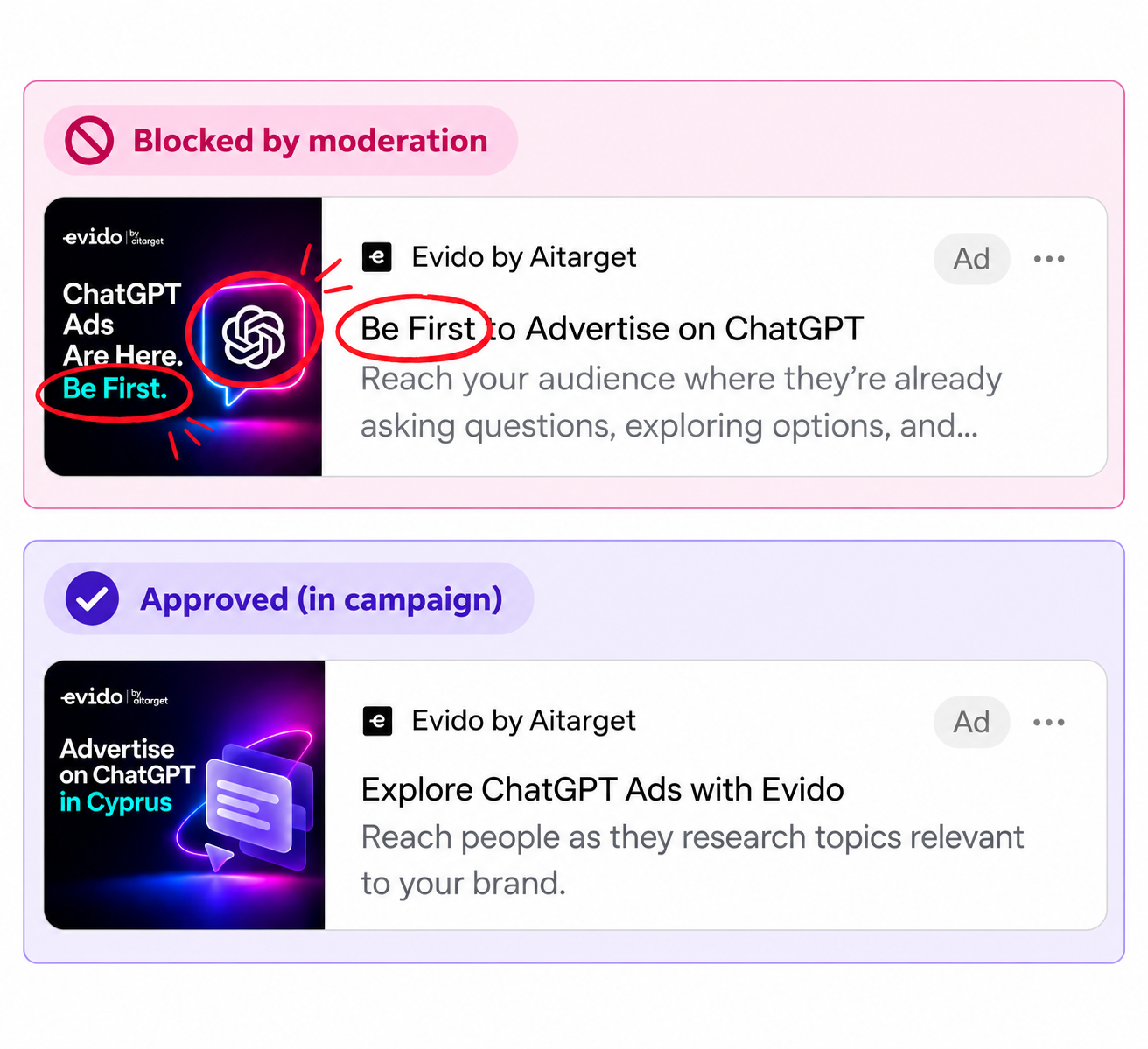
OpenAI's logo and trademarks require written permission from OpenAI, and a partner relationship does not grant it.
That experience gives a buyer something concrete to ask about. If a service includes moderation support, does someone review the landing page and evidence behind the claims? Who prepares revisions, submits them, and follows up when the reason remains unclear?
A useful scope might read: “Review the ad and destination, identify claims requiring evidence, and coordinate revisions through resubmission.” That tells both teams what work to expect.
OpenAI makes the approval decision, so assess moderation support by the work it covers before submission and after rejection.
Self-serve is reasonable when your team can do that work and has time to respond. A partner becomes more useful when review issues repeatedly interrupt launches or require coordination across several people.
A valid test separates delivery problems from weak demand
Experienced teams know how to tell a delivery problem from weak demand. ChatGPT Ads makes that harder in the first weeks, and a partner arrangement adds a handoff to every investigation.
Two platform specifics cause most early false alarms. According to OpenAI's troubleshooting guide, impressions, clicks, and CTR refresh roughly every 15 minutes, while spend can take about 7–8 hours to appear and CPC and CPM update later still. A same-day read can make traffic look cheaper than it is, and a recent charge can include spend the dashboard does not show yet.
The daily budget works as an average within a weekly allowance. One day can spend well above the amount you set, and using the allowance early can stop delivery later in the week.
OpenAI's advertiser FAQ adds that delivery and spend can fluctuate during the beta. It lists verification, review, billing, budget, and campaign dates as potential delivery blockers.
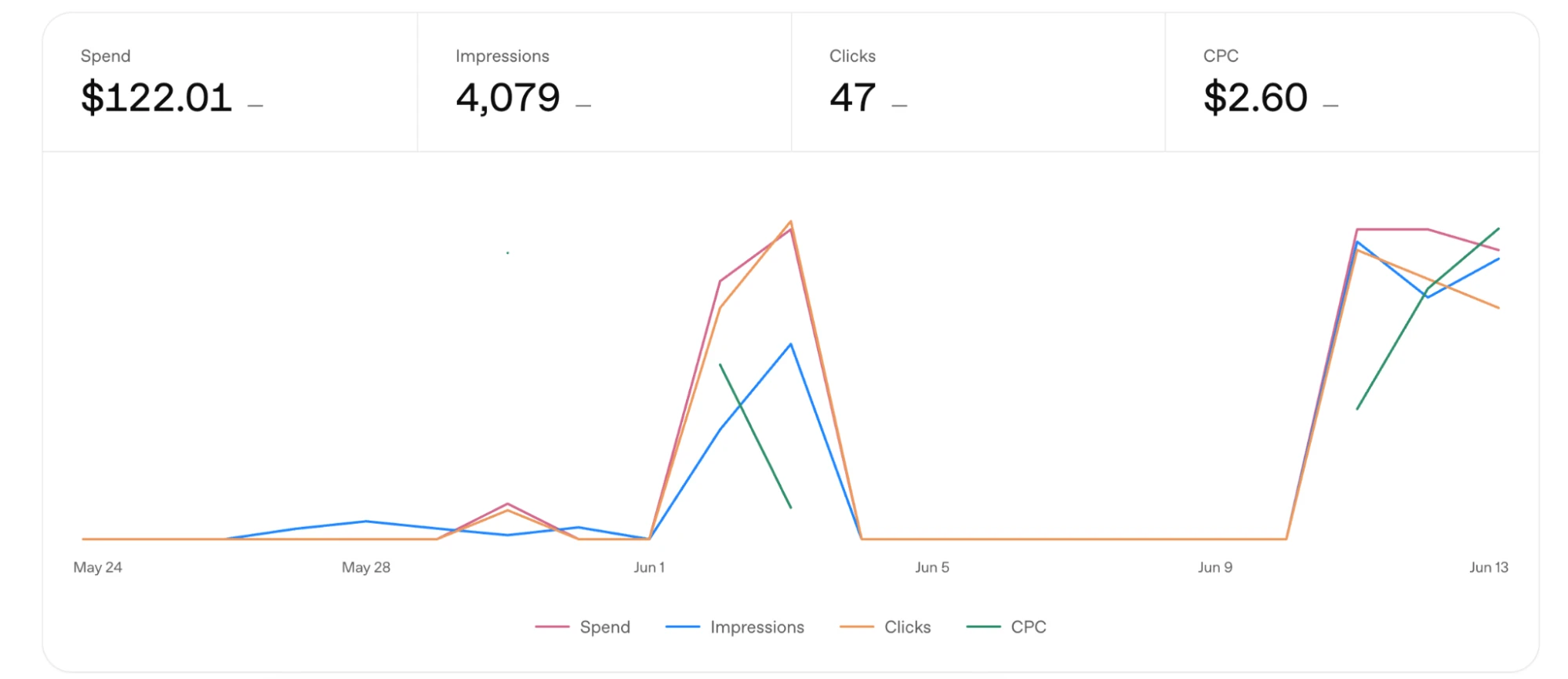
The harder problem is ownership. With a partner-provided account, questions about account status and billing go through the partner, while events and the landing page stay with your developer. Someone on your side has to put both halves together and decide whether the campaign, the tracking, or the offer needs to change.
Our guides to ChatGPT Ads conversion tracking and reporting cover the setup and attribution windows.
When comparing providers, ask how they would investigate an account with clicks and no reported leads, and which data they would need from you. A specific answer shows where their responsibility ends.
Compare the cost of completing the same test
A commission percentage is only comparable when both options cover the same work. Put the planned test on one page, then price the responsibilities in each route.
The useful comparison is:
Total test cost = media spend + external services + internal work + required production and measurement work.
Here is an illustrative calculation for a three-week test. Every figure is an assumption, not a ChatGPT Ads benchmark or Evido by Aitarget pricing: $1,500 in media, an internal rate of $50 per hour, and a flat $300 fee from a hypothetical infrastructure partner.
Internal work assumes 6 hours of setup, 9 hours of campaign management, and 6 hours of moderation follow-up on self-serve. With a partner handling account setup and resubmissions, setup and moderation drop to 2 hours each, while campaign management stays with your team.
In this example, the two routes cost almost the same. The result depends on whether the partner actually removes those 8 hours, so ask which tasks the fee replaces before comparing it with zero.
Label internal hourly rates and expected workload as your own assumptions, so nobody later mistakes the estimate for a ChatGPT Ads benchmark.
For media planning, use our breakdown of ChatGPT Ads bidding and budgets. Then ask each provider to itemize its own charges, minimum commitment, and included work.
A partner can justify its fee by removing work your team would otherwise have to perform. That case is stronger when the task and responsibility are clear. A promise of better results needs separate evidence.
If a provider presents a lower CPC, ask about the market, dates, objective, and conversion quality. Those figures alone cannot establish that the buying route caused the difference.
Choose the arrangement your team can operate
Self-serve fits an advertiser with an eligible account, compatible billing, and a media buyer who has time for the test. It also needs someone who can validate tracking and connect reported outcomes to business results.
A small budget can suit that arrangement, but budget size alone is insufficient. The person running the test still needs time to investigate problems and make changes.
An infrastructure partner fits a different situation: the campaign expertise already exists, while account setup, payments, or launch support need help. This can suit an in-house team or an agency that wants to keep client strategy and creative under its control.
A managed service makes sense when campaign operation itself lacks an owner. Specify whether that includes creative production, landing-page recommendations, tracking implementation, and analysis. Each omitted task still needs someone.
There is also a reason to postpone. If the offer cannot run in the intended market, or nobody can evaluate the business outcome, changing providers will not resolve the underlying gap. Our article on who should test ChatGPT Ads and who should wait covers that earlier decision.
Before committing, request a written answer to four questions:
- What can this account run? Confirm the entity, target markets, and any launch conditions.
- Who handles a blocked launch? Identify the person responsible for investigation and follow-up.
- Who owns the test decisions? Name the people responsible for campaign changes, measurement, and sales feedback.
- What remains if we change providers? Confirm account access, reporting exports, creative files, and any transfer limitations.
In self-serve, an account administrator can add colleagues through Settings → Users → Invite. With an API partner, your team may build and run campaigns in the partner's interface without logging in to OpenAI Ads Manager at all.
Confirm your access and handover terms before launch, and do not assume that campaign history or billing arrangements can move automatically.
Define the first test before choosing the provider
Write a short brief describing the buyer, market, offer, success criterion, available team, and problems you need outside help to resolve.
That brief gives you a basis for evaluating both routes. It also gives you a way to review the arrangement after the first test: which tasks still need support, and which can your team handle?
For teams outside OpenAI's supported countries, the missing piece is usually the account itself: a legal route to open it, pay for it, and get the first ads through review.
At Evido by Aitarget, we provide ChatGPT Ads access through our API integration, including for advertisers whose company cannot register for self-serve. We also offer creative review, moderation support, and local invoicing under agreed terms, while strategy and campaign decisions can stay with your team.
Your team sets up campaigns, ad groups, and ads, follows moderation, and reviews statistics directly in the Aitarget platform, without logging in to OpenAI Ads Manager. The account is usually created within minutes of the application; OpenAI's brand and account review can then take up to 9 hours, and ad review from an hour to a day.

If your team is ready to test but needs help with access, billing, or moderation, send Evido by Aitarget your website, legal-entity country, and target markets. You'll get a clear answer on whether we can open an account for that setup, how billing would work, and which launch conditions apply.