ChatGPT accepts ads for consumer goods, travel, education, and digital products. OpenAI ad policies prohibit categories including gambling, alcohol, and dating, while regulated offers depend on the product, market, and advertiser's approval.
The difficult decisions usually involve a specific offer. A business might operate a recruitment platform, sell financial software, or run a resort with a casino. Its industry label alone gives a media buyer too little information to plan the campaign.
Before commissioning creative, identify what the customer will buy or sign up for, where the ad will send them, and which countries the campaign will target.
Examples below are illustrative planning scenarios, not reported moderation outcomes.
What OpenAI ad policies allow and prohibit
The advertising policy provides the starting point:
Use this table to eliminate clearly unsuitable offers. For a mixed business, continue with the exact service and destination.
Write the offer in one sentence before choosing a category. For example: “A subscription that helps small businesses organize invoices” is much clearer than “a fintech platform.” Keep that sentence beside the campaign brief, so the performance marketer and copywriter work from the same description.
Regulated categories depend on the product and country
OpenAI's eligibility table distinguishes ordinary category eligibility from access limited to selected advertisers. Selected examples show why a single rule for “finance” or “health” is insufficient:
“Allowed” describes the category; it does not approve an individual account or ad. “Other countries” does not establish country availability. OpenAI also says it is not accepting new approval applications in certain restricted categories and is working with a small group of advertisers there.
The main policy uses broad language about non-US financial restrictions. The detailed table identifies specific exceptions, so use both documents and confirm the proposed arrangement for the actual advertiser.
For an agency, this changes the brief you request from a client. Ask for the product name, target country, and any existing category approval before estimating launch dates. A license answers a different question from whether OpenAI has admitted that advertiser to the program.
A borderline offer gets approved if the landing page doesn't cross the line
A recruitment platform and a specific vacancy
OpenAI allows ads for job-search platforms, provided neither the ad nor the landing page refers to specific vacancies. The same rule applies to property platforms and individual listings.
For example, “Find your next job” can lead to a page describing the platform's search tools, without displaying individual listings. The same ad cannot lead to a “Marketing manager at Company X” vacancy page.
A draft for the platform could read:
Title: Search jobs by role and city
Copy: Filter openings by salary and schedule, and get alerts when new roles appear.
The ad itself describes the platform, but the landing page needs the same check. If the search page opens with a “Vacancy of the week: Marketing manager at Company X” block, the destination now references a specific listing. Send the ad to a page about the search tools, without featured vacancies.
A hotel stay at a casino resort
OpenAI may allow ads for hotel stays at casino resorts when gambling is not the focus.
For example, an ad for a weekend stay could highlight the rooms, restaurants, and pool, and link to a page for booking accommodation. An ad offering a betting bonus promotes gambling and is not allowed, even if it also includes a hotel stay.
A draft for the stay could read:
Title: Weekend stay by the sea
Copy: Book a sea-view room with breakfast, spa access, and late checkout.
The ad itself promotes accommodation, but the landing page needs the same check. If the booking page also offers “$50 free play at the casino with every booking,” the destination now makes gambling part of the offer. Send the ad to a room-booking page without casino promotions.
Software and a financial transaction
OpenAI allows ads for financial software, such as tools for creating invoices and tracking payments. If the same company also offers business loans, it must check whether those loans are eligible for advertising separately.
For example, an ad for an invoicing subscription falls under financial software. An ad offering a business loan is subject to the rules for lending, including restrictions on the target country and advertiser eligibility.
A draft for the software alone could read:
Title: Invoicing for small businesses
Copy: Create invoices, send payment reminders, and see which clients have paid.
The ad itself stays within financial software, but the landing page needs the same check. If the invoicing page also carries a “Get a business loan in 24 hours” banner, the destination now promotes lending. OpenAI's policy says approved creatives may not link to destinations that introduce disallowed content. Send the ad to a page about invoicing only, without the loan offer.
For each scenario, the practical task is to describe the real offer accurately. If the business cannot separate the proposed service from an ineligible proposition, pause campaign production and resolve that issue first.
Even in a permitted category, ads get rejected for unsupported claims or someone else's logo
OpenAI's creative guidance requires the ad, image, and landing page to comply together. It recommends specific, useful copy and a relevant destination rather than a generic homepage. Ads with misleading statements or mismatches between the text and the page get rejected.
Consider a hypothetical project-management subscription. The ad promises a free trial, but its link opens a pricing page that only offers annual contracts. Before rewriting the headline, establish whether the trial exists, who qualifies, and where visitors can start it.
If a 14-day trial is available, a concrete draft could read:
Title: Project planning for small teams
Copy: Assign tasks, track deadlines, and try the shared workspace free for 14 days.
The destination should explain that same trial and its conditions. The team should verify every feature and term before using this example. This wording does not guarantee approval.
In the accounts we run, a chat card title takes up to 50 characters and the body up to 100, and the image must be at least 640×640 pixels. The draft above uses 32 and 77 characters. If a claim only holds with a footnote, it will not fit, and it probably should not be in the ad.
Create a short evidence note for any numerical performance claim. Record what was measured, who was included, and where the supporting material can be found.
Evido by Aitarget's first ChatGPT Ads campaign took four submissions before launch, and the rejection feedback did not always name the element at fault. Two things changed between the blocked and the approved version: we removed a “Be First” claim and the OpenAI logo.
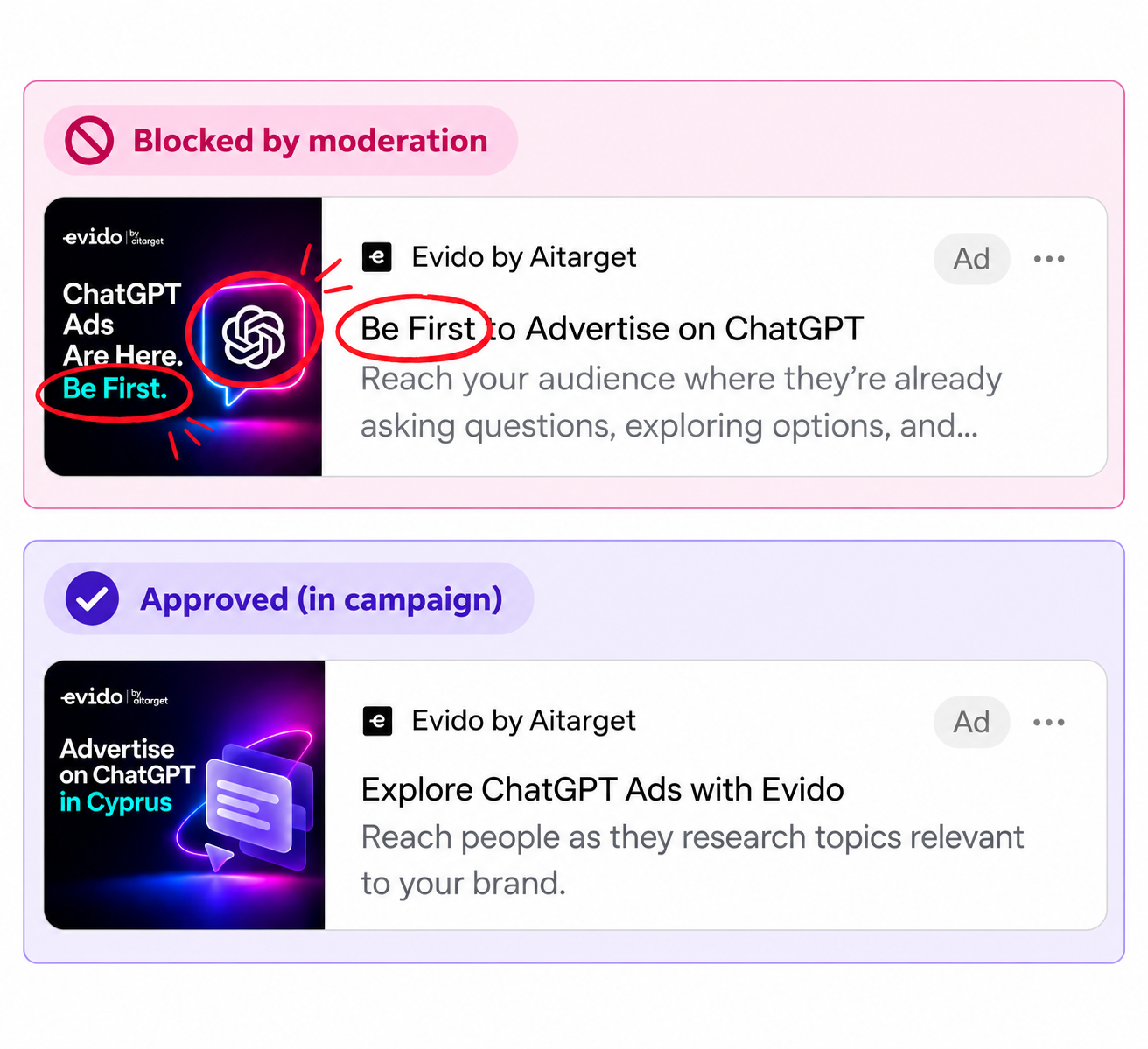
Both changes follow from the policy. A “first” or “best” claim is a comparison that needs support, and advertisers may use only the trademarks they own or are authorized to use. Promoting a ChatGPT-related service does not change that: OpenAI's logo needs written permission, and working through an OpenAI partner does not grant it.
The policy also prohibits imitating the ChatGPT interface. Include the visual in the review alongside the text; someone should be able to identify the advertiser without mistaking the creative for an assistant response.
We recommend reviewing the ad and landing page in one sitting. Have someone outside the creative team read the ad, open the destination, and describe what they believe they are being offered. Any disagreement is worth resolving before submission.
Eligible ads still face placement limits
Even an approved ad won't appear in every relevant conversation. OpenAI's user-facing explanation excludes sensitive conversations, including personal health, mental health, and politics. Temporary Chats and accounts identified as under 18 also do not show ads.
That matters when planning demand. A product team may identify a real customer need in a sensitive conversation, yet still have no advertising opportunity there. Do not turn those conversations into promised reach in a client proposal.
Context hints describe situations where an offer may be relevant. They guide matching but do not guarantee a placement. For practical examples, use our guide to writing ChatGPT Ads context hints.
Build a shortlist of ordinary purchase or comparison situations that fit the product. Then ask whether the campaign still has a useful purpose without relying on sensitive conversations. If its entire rationale depends on reaching people in a vulnerable moment, revisit the channel choice.
Explain the ad's role to clients and stakeholders in advance. OpenAI says advertisers cannot influence ChatGPT's answers, and a paid placement does not constitute its endorsement.
When ChatGPT ad review fails, identify the layer first
A rejected ad, an inaccessible page, and a campaign with no impressions need different investigations. OpenAI's troubleshooting guidance directs advertisers to inspect the reason attached to the ad's status, then correct the issue or request another review.
These are suggested responsibilities, not official escalation categories. Assigning an owner helps avoid repeated copy edits while a technical or account issue remains untouched.
For page validation, OAI-AdsBot must be able to reach the destination. OpenAI also recommends OAI-SearchBot. Check robots.txt, firewall and CDN rules, authentication, bot challenges, and rate limits; a page opening in your browser does not prove crawler access.
Ask the web team to test the submitted URL and inspect the relevant logs. Keep the failure details with the ad record, so the next person can see what changed. After access is fixed, OpenAI says affected ads may need resubmission.
For an incorrect individual-ad decision, use the appeal option or Request Review in Ads Manager. According to the onboarding and policy guide, Ads Support is for cases with no appeal option or an appeal pending for more than 7 days, and the request should include the ad account ID and the issue category. Keep the decision, submitted assets, and destination together so the appeal addresses the stated issue.
Plan the timeline with resubmission in mind. In our campaigns, a single ad review has taken anywhere from an hour to a day, so a launch that needs three or four attempts can slip by several days.
If approval is complete, investigate delivery separately. OpenAI's developer documentation distinguishes an active ad from an approved ad and lists other delivery blockers. Our ChatGPT Ads reporting guide covers the measurement checks that follow.
You're ready to test when the offer, market, and landing page are checked
You also need someone who can resolve questions about the business and make website changes if required.
Wait if category approval remains unresolved or the business is still deciding what it wants to promote. Producing many variations at that stage multiplies assets that may need to be replaced.
Self-service access has its own requirement: the legal entity advertising and receiving the bill must be based in an available country. Record that entity separately from the countries where you want to reach customers. If the entity qualifies, our walkthrough of OpenAI Ads Manager shows the setup step by step. If it does not, the account is opened through a partner, and campaigns run in the partner's interface. We compare the two routes in ChatGPT Ads through a partner vs self-serve.
Before submission, ask the campaign owner to answer six questions:
- What is the exact offer? Name the product, customer action, and destination URL in one brief.
- What supports its eligibility? Save the relevant policy reference and any account-specific approval, with the review date.
- Which markets are planned? Record the advertiser's location and intended delivery countries separately.
- Can we support the message? Check the price, features, trial conditions, and evidence behind any result claim.
- Can the destination be reviewed? Ask the website owner to confirm crawler access to the submitted page.
- Who handles a rejection? Assign an owner and keep the submitted version, decision, and subsequent changes together.
This brief also helps with later handovers. A colleague should be able to see why the team selected an offer without reconstructing the decision from messages or guessing which page was originally reviewed.
OpenAI ad policies: questions before launch
Why was my ChatGPT ad rejected if the product is allowed?
A permitted category still leaves the creative and destination to check. Read the stated reason and inspect the affected assets; category eligibility alone does not establish that the submitted ad meets every requirement.
Can I fix a rejected ad by pausing and restarting it?
No, changing an ad's configured status does not approve rejected creative or complete a pending review, according to OpenAI's review documentation. Address the underlying issue.
Will editing an approved ad trigger another review?
Yes, editing creative submits a new version for review. Brand changes can also trigger account review, so keep a record of what was changed and leave room for that process in launch planning.
Can I use the OpenAI or ChatGPT logo in my ad?
Not without written permission from OpenAI. The policy allows only trademarks you own or are authorized to use and prohibits implying endorsement or affiliation. Removing the OpenAI logo was one of the changes that got our own first ad approved.
Can advertisers see the conversation that triggered an ad?
No, OpenAI does not share users' private chats with advertisers. If someone chooses to message an advertiser directly through an ad, the advertiser can see those messages; that does not expose the preceding ChatGPT conversation.
Does an account in an available country make every offer eligible there?
No, account access does not establish eligibility for every product. Assess the actual offer and intended delivery countries before committing to launch.
Can any AI tool advertise as a digital product?
Do not assume automatic eligibility. OpenAI's policy reserves discretion to decline advertising, including for competitive reasons; confirm the specific product before planning a launch.
Bring one concrete offer to the launch discussion
The most useful output of a policy check is a decision the team can act on: proceed with this offer, resolve this specific question, or hold the campaign. Keep the supporting information beside that decision so later edits have a clear starting point.
Even with an eligible offer, two obstacles often remain: a company whose country is not open to self-serve, and a review loop with feedback too broad to act on quickly.
Evido by Aitarget provides ChatGPT Ads access through our own API integration, including for advertisers whose market is not directly available. Your team creates campaigns, ad groups, and ads directly in the Aitarget platform and tracks review status and reporting there, without logging in to OpenAI Ads Manager. Before submission, we check the creative, landing page, and domain against policy, and if an ad is rejected, we handle the appeal.
If you are preparing a ChatGPT Ads campaign, send us the offer, destination URL, and target countries. You'll get our assessment of whether that offer can run in those markets, which questions still need an answer from OpenAI, and what to change in the ad or landing page before the first submission.