If your team already runs paid media, choose a ChatGPT Ads partner by checking how it will help you operate the channel yourself. Account setup, payments, campaign controls, and support should all be clear before you fund the account.
For advertisers and agencies adding ChatGPT Ads to their media plans, the practical questions start with everyday work. Can your media buyer change an ad directly? How does finance fund the account? Who investigates when a payment or account update gets stuck?
Ask each potential partner to demonstrate that workflow using the interface your team will use. Its answers should show how your team will launch campaigns and keep them running.
Evido by Aitarget has its own interface for ChatGPT Ads. Advertisers and agencies use Aitarget to open and fund accounts, create and edit campaigns, and check moderation and performance. We connect that interface to OpenAI as a Channel Partner through a direct API integration.
1. What does the partner add if we can register directly?
Check the direct route before comparing partner proposals. OpenAI’s self-service availability list includes Kenya, Nigeria, Azerbaijan, Kazakhstan, and Uzbekistan, alongside the UAE and Saudi Arabia. Eligibility depends on where the legal entity advertising and receiving the bill is based.
For an eligible company, a partner needs to explain which operational needs its service addresses. You may want to fund ChatGPT Ads through the advertising platform your finance team already uses. Your media buyers may need help resolving account problems or interpreting moderation feedback.
For an agency managing several clients, the requirements also include account organization, funding, and access to each client’s statistics. Ask the partner to show how those tasks work across the accounts your team will operate.
Ask the provider to identify what is included in its fee and what remains with your team. “Access to ChatGPT Ads” alone gives an eligible advertiser little basis for comparing the service with direct registration.
For companies outside the self-service list, ask whether the partner can support the actual advertiser and intended markets. Our partner vs self-serve comparison covers that earlier choice. Country availability and account-specific conditions still need checking for the proposed campaign.
2. What can our team do in the partner’s interface?
Request a demonstration of the interface your team will use. Ask the provider to create a draft campaign, open its ad groups, edit an ad, and show where a user pauses delivery.
This establishes how everyday work gets done. If a retailer withdraws a promotion, the media buyer needs to stop the relevant ad. If the next change requires a message to an account manager, that dependency belongs in the service discussion.
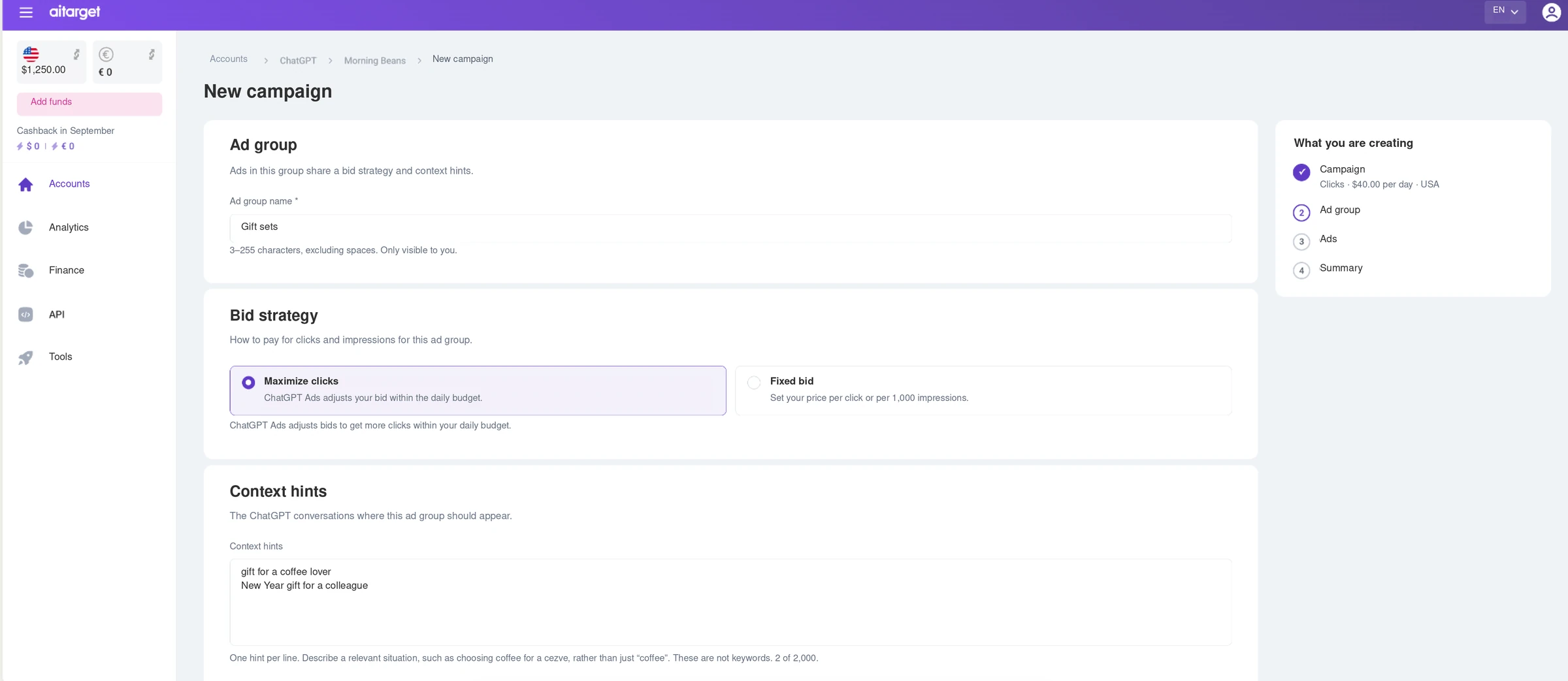
In Aitarget, clients work directly in our interface. They request an account, allocate funds from their wallet, and create campaigns, ad groups, and ads. They can edit or pause advertising and see review statuses and statistics in the same workspace.
There is no separate OpenAI Ads Manager login in this workflow. The API connection runs behind our interface; your media buyers use the campaign controls themselves.
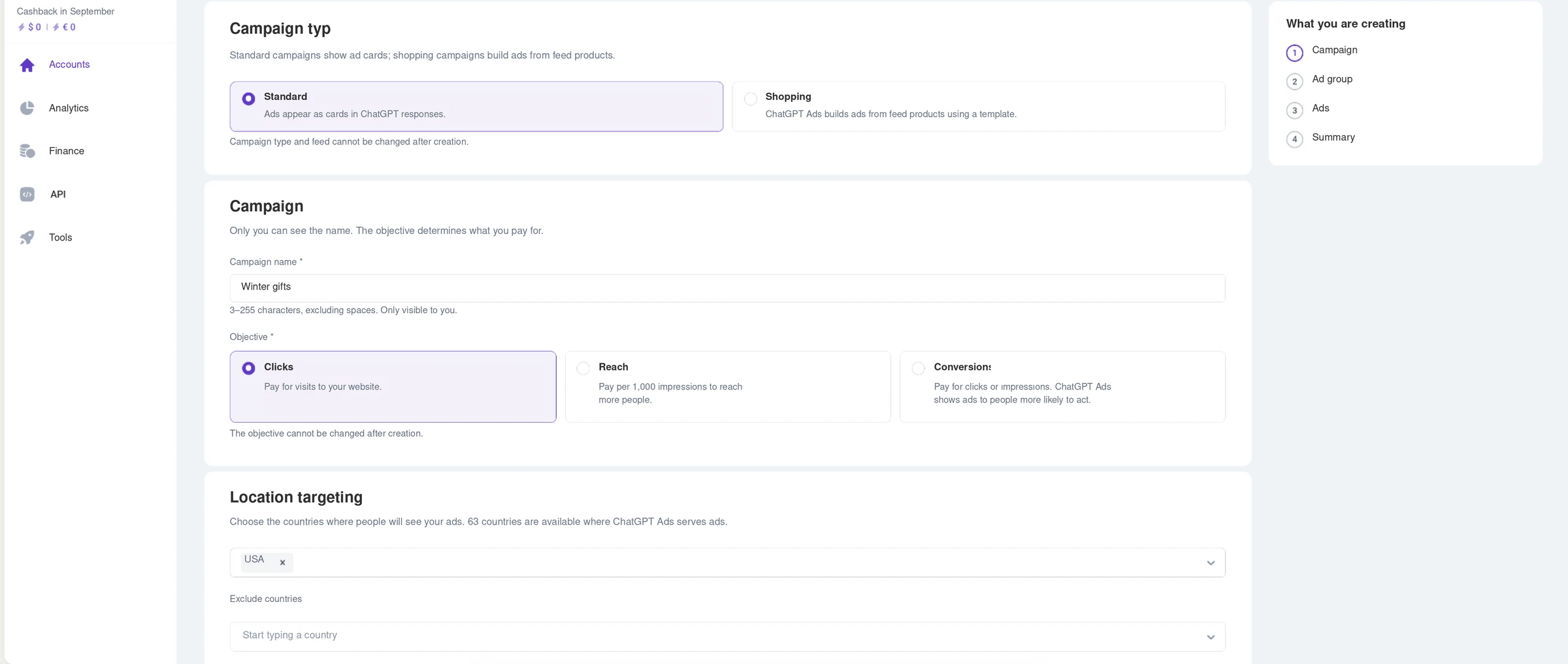
During the demonstration, check the actions your team performs most often:
- creating campaigns, ad groups, and ads;
- changing the settings and assets your workflow requires;
- pausing campaigns and checking their status;
- reviewing performance for a chosen period.
Ask which functions require support or are unavailable in that interface. OpenAI’s feature set and a partner’s implemented features may differ. A feature announced by OpenAI should enter your media plan only after you confirm that your chosen route supports it.
3. What has to happen before the account can advertise?
Ask the partner to explain account creation and review as separate stages. An accepted application does not establish that the brand, account, and ads have passed every required check.
The setup instructions should tell your team what to prepare and where it will see progress. In Aitarget’s account request form, clients provide brand details, a website, a logo, and an account time zone. The account uses USD, and its currency and time zone cannot be changed after creation.
Those details affect work beyond the application form. Finance needs to know the account currency, while the media buyer needs to understand the time zone used for campaign dates and reporting.
For a launch coordinated across several markets, ask the provider to check the proposed account and intended delivery countries before you commit to the schedule. OpenAI’s campaign guidance describes initial home-country restrictions for some new self-serve accounts. Confirm the conditions of the specific route offered to you.
The provider should also show where requests for missing information and review outcomes appear. If creation fails, you need to know who investigates and what your team must supply.
Judge a launch estimate by its dependencies. A useful answer separates the partner’s setup work from OpenAI’s checks and from any corrections required from your business.
4. How do funding, fees, and invoices work?
Ask the partner to walk finance through one complete payment: the amount paid, the fees applied, the amount available for advertising, and the document issued.
Separate the account currency from the currency and method available for paying the partner. They may differ. If the proposal includes local billing, confirm the available arrangement for your legal entity and request a sample invoice.
A shared advertising wallet can simplify an existing workflow. In Aitarget, the client allocates funds from its wallet to the ChatGPT Ads account. That makes account funding part of the platform the client already uses, while campaign spending remains visible against the relevant account.
Ask what happens between a top-up and the funds becoming available. If account setup is incomplete or a payment update is delayed, the provider should explain the status and the next action. Your team should know how to distinguish an unfunded account from a funding update still in progress.
Compare commercial terms on the same basis:
A deposit requirement and a campaign budget serve different purposes. Finance should understand both, including any conditions that limit how the remaining balance can be used.
5. What help do we get before and after ad rejection?
Ask what the partner reviews before submission and what happens if OpenAI rejects an ad. Creative review should cover the message, image, and destination together.
Consider an electronics retailer advertising installation with a purchase. The destination needs to explain which products qualify, where installation is available, and any additional charge. A reviewer can flag a mismatch, but your team still needs to verify the offer and authorize changes.
Technical access matters too. OpenAI requires its advertising crawler to reach the destination. A page can open for your media buyer while a firewall blocks the crawler. Resolving that issue involves the website team.
Ask the partner to show where rejection reasons appear and explain how you request further help. In Aitarget, review statuses and rejection reasons appear on the relevant account or ad card. Changes to an ad’s headline, text, link, or image trigger another review, so allow for that when revising an offer.
A useful support arrangement identifies who explains the issue, who edits the assets, and who handles escalation where available. It also makes clear that OpenAI decides whether the ad can run.
Our OpenAI ad policy guide covers the underlying requirements. When evaluating a partner, check how its service helps your team apply them to a real submission.
6. Can we inspect performance without waiting for a report?
Ask to see the reporting interface available to your users. Your media buyer should know which figures it can inspect, at what level, and for which dates.
Start with a routine task: finding the spend and clicks for one campaign during a promotion. Then check whether the interface lets you investigate individual ad groups or ads. For your regular reporting process, ask which exports or other data-access options the partner supports.
Aitarget’s campaign workspace includes campaigns, ad groups, and ads, with search, status filters, and date selection. Clients follow statistics inside the platform. Confirm the precise metrics and output format you need during onboarding, especially if your agency consolidates several clients’ reports.
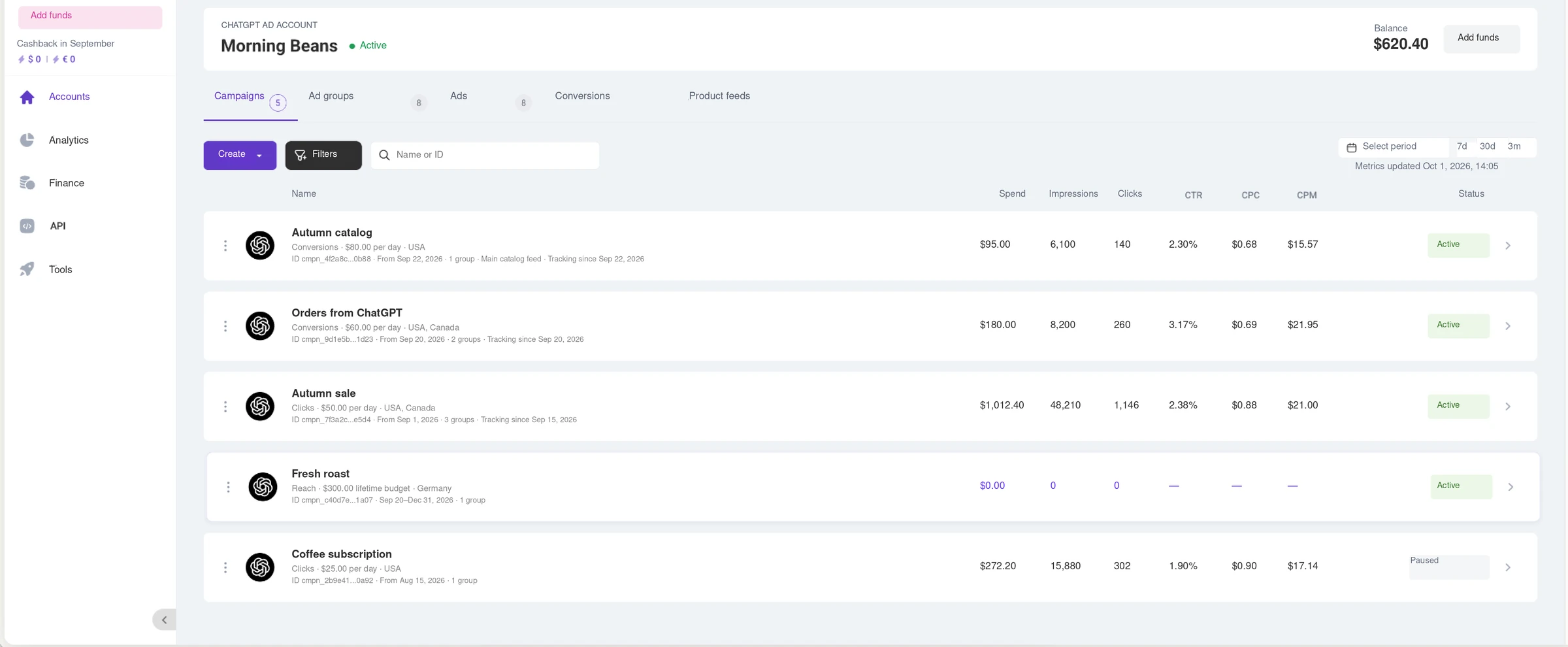
Data timing also needs an explanation. A partner interface depends on both OpenAI’s reporting and its own updates. Ask how support distinguishes a delay at the source from a synchronization problem. A stale figure should not become the basis for a budget change.
Campaign statistics are one part of your measurement process. Your team still needs to connect visits and conversions to business outcomes. Clarify who handles tracking implementation and which measurement features the proposed integration supports.
Our guides to ChatGPT Ads reporting and conversion tracking explain the measurement work. Confirm which setup tasks the partner supports and assign the remaining work to the relevant people on your team.
7. Who investigates account and platform problems?
Test the support process with an operational example. Your team has funded the account, but the available balance has not updated and a campaign cannot start. Ask who checks the payment, the account status, and the connection to OpenAI.
The person answering should explain which checks the partner can perform itself and when it needs OpenAI or your team to act. A contact who can investigate account operations is more useful in that situation than someone who can only forward a message.
Another example is an account whose statistics have stopped updating. Your media buyer needs to know whether advertising continues and whether the figures are current enough to use. Support should be able to distinguish a reporting problem from a delivery problem.
Our automated process includes monitoring for account-creation failures, delayed synchronization, and discrepancies in spending limits. Those checks support investigation; they do not establish a guaranteed resolution time.
Request the support channel, working hours, and escalation process that apply to your account. Ask what information your team should include in a request and who provides updates while it remains open.
Keep campaign decisions with the agreed owner. A partner may investigate why an account is blocked, while your media buyer decides whether to change the offer or allocate budget elsewhere. Clear responsibilities make it easier to act when several teams are involved.
8. What happens when our setup or provider changes?
Ask about changes before they become urgent. An advertiser might change its campaign team, reorganize its billing, or decide to buy directly. Each change can affect access and account arrangements.
A partner-operated account may depend on the partner’s integration. Confirm whether the account can transfer, whether campaign history remains accessible, and which elements would need to be recreated. Avoid assuming that access through a partner automatically includes a future OpenAI Ads Manager login.
For an agency, check how the arrangement handles a client moving its work elsewhere. Establish who can receive the client’s assets and reports, how access ends, and how the remaining balance is settled. The process should protect other clients’ information.
Keep a usable record of your own work throughout the engagement: approved assets, destination URLs, campaign settings, and the context hints your team created. For guidance on those inputs, see our article on writing ChatGPT Ads context hints.
Have the provider explain the available handover options in writing. A report export may preserve performance figures while leaving other parts of the setup dependent on the original account. Knowing those limits helps your team choose an arrangement it can operate over time.
Choose a ChatGPT Ads partner around your existing team
Bring your media buyer and finance contact to the same product demonstration. Ask them to follow a campaign from account creation and funding through submission, reporting, and a support request. That exercise will expose missing steps before a live launch depends on them.
An infrastructure partner fits an advertiser or agency that wants to run its own campaigns with additional operational support. Direct self-service can be sufficient when the company qualifies and its team can handle account setup, payments, and troubleshooting.
Evido by Aitarget combines its own ChatGPT Ads interface with account funding and operational support. Your team works in Aitarget, using its campaign controls and reporting to manage the advertising directly.
If your team wants to run ChatGPT Ads through that setup, send Evido by Aitarget your website, legal-entity country, target markets, and billing requirements. We’ll explain the available account arrangement, commercial terms, and support for your team.