A customer sees your product on Instagram, searches for alternatives on Google, and asks ChatGPT to help make the final choice. All three platforms may have influenced the purchase. But the last-click report will give most of the credit to whichever ad brought the customer back before converting.
This is one reason comparing ChatGPT Ads, Google Ads, and Meta Ads by CPC or CPA alone can lead to the wrong budget decision.
By October 2026, ChatGPT Ads already supports impression, click, and conversion objectives, custom audiences, and product advertising. It is a working performance channel, although its inventory and track record remain smaller than those of Google and Meta.
The practical question for media buyers is where ChatGPT adds opportunities that existing campaigns are missing, how much budget those opportunities deserve, and what evidence would justify spending more.
ChatGPT Ads vs Google Ads vs Meta Ads: the difference starts with buyer intent
All three platforms can reach people considering a purchase. The difference is how they recognize that interest and when an ad becomes relevant.
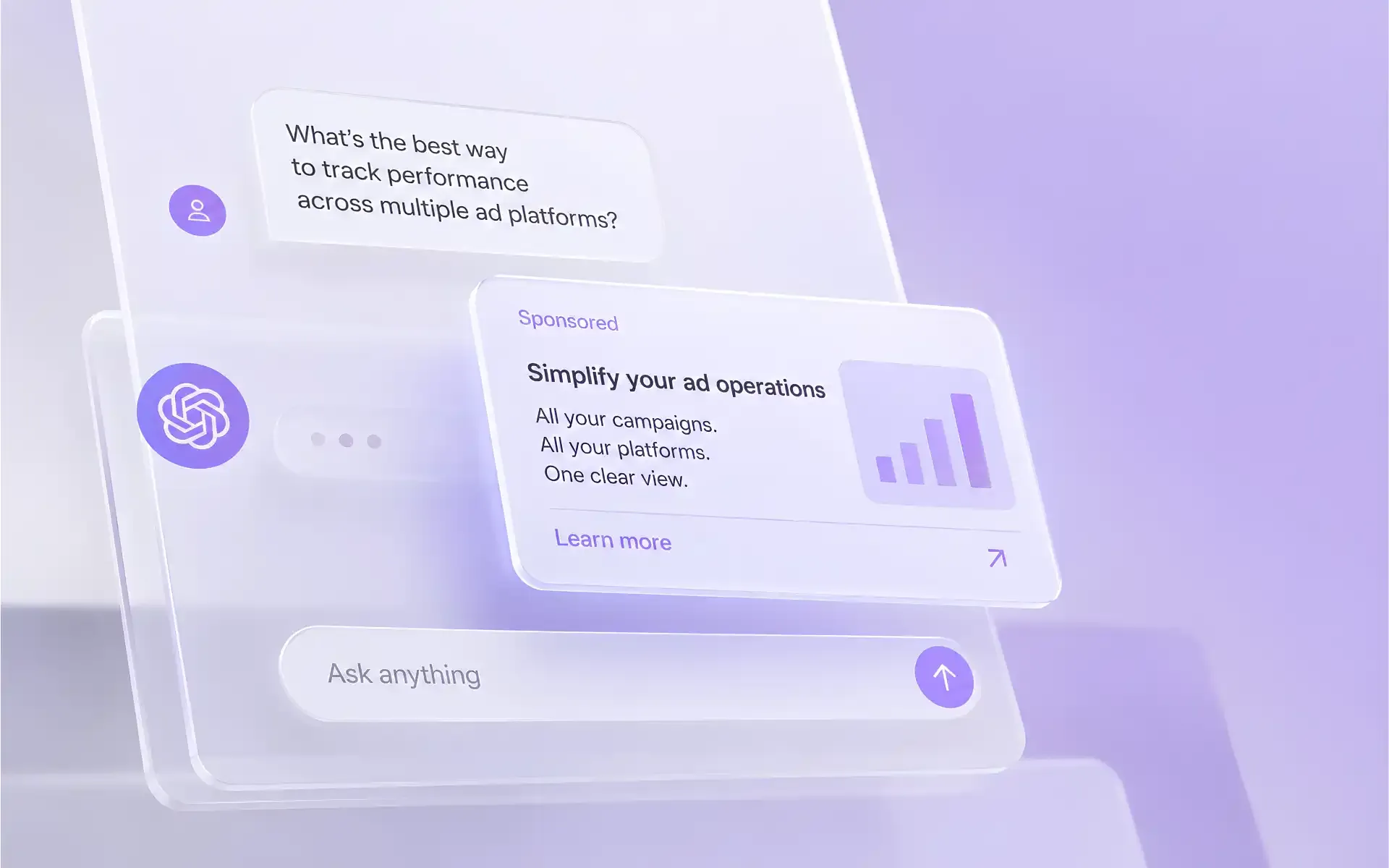
Google Search observes what someone searches for. Meta uses signals such as engagement, behavior, and conversion data to find people likely to respond to an advertisement. ChatGPT can use the context of a conversation in which someone explains a problem, considers alternatives, and refines their requirements.
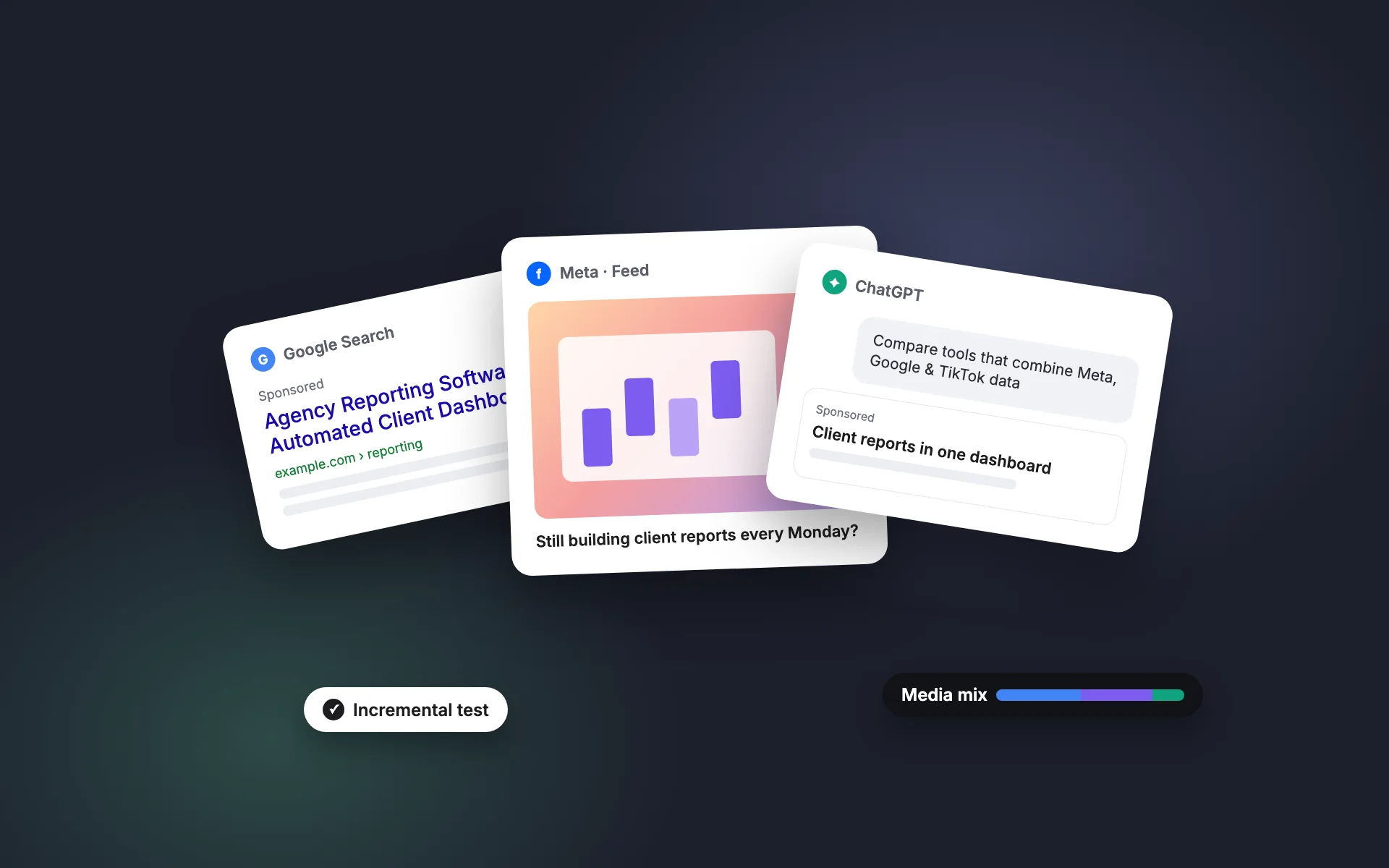
For example, someone looking for reporting software might:
- Search Google for "marketing reporting software for agencies."
- See a Meta ad demonstrating how an agency automates client reports.
- Ask ChatGPT to compare tools that combine Meta, Google, and TikTok data without requiring a developer.
The customer need is similar. The information available to each advertising system is different.
These are typical strengths, not exclusive territories. Google can generate demand outside Search. Meta can convert buyers who already know what they want. ChatGPT can reach someone close to purchase.
The distinction matters because a media plan should allocate budget according to the commercial opportunity, rather than assigning each platform a fixed stage of the funnel.
Google Ads remains essential when demand is already visible
Google Ads is particularly useful when people can express their need through a search.
A person searching for "CRM software pricing" has already narrowed the problem. The advertiser can organize campaigns around commercial queries, control landing pages, and optimize toward leads or sales.
That is valuable demand. If those campaigns consistently bring profitable customers, moving budget away from them simply because a new platform has appeared needs a strong justification.
But Google Ads should not be reduced to keyword targeting.
Performance Max uses Google's AI to find conversions across Search, YouTube, Display, Discover, Gmail, and Maps. Demand Gen also reaches potential customers before they actively search for a specific product.
Google has expanded into AI-assisted discovery as well. Ads can appear above, below, and, in supported markets, within AI Overviews. These placements use existing eligible Google Ads campaigns rather than a separate ChatGPT-style advertising account.
This creates some overlap with ChatGPT.
Someone asking Google why their reporting process takes too long may see an AI-generated explanation accompanied by relevant advertising. Someone discussing the same issue in ChatGPT may encounter an ad related to their requirements.
The important distinction is the environment. Google starts with a search interaction, even when AI expands its understanding of the query. ChatGPT can consider the evolving context of a conversation across multiple turns.
For advertisers, the implication is straightforward: keep Google campaigns that capture profitable demand, but examine whether conversational research reveals needs that your existing search strategy does not address.
Meta Ads can create demand before buyers start comparing solutions
Meta has a different advantage.
People scrolling Instagram or Facebook are not necessarily looking for reporting software, a travel package, or a new pair of running shoes. A relevant creative can introduce the problem, demonstrate the product, and give them a reason to investigate.
For a reporting platform, a short video showing the difference between assembling reports manually and using an automated dashboard may generate interest from someone who had not planned to research reporting tools that day.
Meta's AI-driven advertising systems can then optimize delivery toward people more likely to engage or convert. Its Advantage+ solutions cover established performance objectives, including sales and lead generation.
Meta also has an important role after the first interaction.
A potential customer may visit a product page from Google or ChatGPT, leave without converting, and later respond to a Meta retargeting ad. That final interaction may produce the conversion recorded in the campaign report.
This makes Meta useful across multiple stages of acquisition. It also makes attribution more complicated.
A successful Meta campaign may be converting demand introduced elsewhere. If the original source becomes invisible in reporting, the team can overestimate the value of the final touchpoint.
For media buyers, Meta's creative and audience capabilities remain valuable. The new question is whether ChatGPT can introduce additional qualified prospects into that system.
ChatGPT Ads reaches buyers while they are defining what they need
Consider a company choosing a new CRM.
The initial question might be about organizing sales leads. A few messages later, the user explains that the company has 15 employees, uses spreadsheets, needs WhatsApp integration, and cannot afford a long implementation.
By that point, the conversation contains substantially more context than the original question.
OpenAI described this distinction in its October 21, 2026 explanation of the ChatGPT advertising system. Its ad-selection system interprets evolving conversational intent, retrieves relevant candidates, evaluates their suitability, and runs an auction.
Advertisers provide context hints, which explain what a product offers, who it serves, and when it may be useful. These hints contribute to relevance matching. They are not exact-match keywords and cannot guarantee placement in a particular conversation.
The system also considers the ad, landing page, targeting settings, and other eligible signals.
This creates an opportunity for products whose value depends heavily on the customer's circumstances.
A CRM for small sales teams and an enterprise CRM might compete on similar Google keywords. In ChatGPT, a discussion about team size, implementation resources, and required integrations gives the advertising system additional context to assess relevance.
The advertiser still needs an offer that addresses the actual requirement.
There are also important boundaries.
Ads appear separately from ChatGPT responses and do not influence the assistant's answers. Advertisers cannot buy a place in an organic recommendation or receive users' private conversations.
The addressable audience is narrower than ChatGPT's total user base. Ads are shown to eligible adult users on Free and Go plans, while Plus, Pro, and business subscriptions remain ad-free.
That limitation matters for B2B advertisers. A company may want to reach enterprise software buyers, but it cannot assume those buyers are reachable through their corporate ChatGPT accounts.
ChatGPT Ads also supports conversion optimization through its measurement infrastructure. The channel should therefore be evaluated for business outcomes rather than treated as a visibility-only placement.
Still, the availability of a conversion objective does not establish that ChatGPT will produce conversions at the same cost or volume as an established Google or Meta campaign.
The same product needs a different message on each platform
The easiest mistake when adding ChatGPT Ads is copying a successful Google or Meta campaign into the new interface.
The offer may stay the same. The message should reflect what the customer is doing when the ad appears.
Take a fictional SaaS company selling automated reporting software to marketing agencies.
The Google message is closely aligned with a search term. Meta introduces an operational problem that can be demonstrated visually. ChatGPT connects a specific combination of requirements to a potential solution.
For the ChatGPT campaign, the advertiser could add a context hint describing:
"Reporting software for marketing agencies managing campaigns across Google Ads, Meta Ads, and TikTok Ads, especially teams consolidating client performance data into recurring reports."
This is an illustrative hint for a product that genuinely supports those integrations. It describes the offering and its relevant use case rather than trying to instruct ChatGPT to display the ad.
OpenAI's context-hint guidance recommends specific, accurate descriptions of what the product does and when it helps.
The landing page matters just as much as the creative.
If the ChatGPT conversation concerns combining three advertising platforms, a generic homepage may leave the visitor searching for evidence that the integrations exist. A page showing supported integrations, reporting capabilities, and relevant use cases would address that question more directly.
The strongest message for each platform may therefore lead to a different destination, even when all three campaigns promote the same software.
Last-click attribution can make ChatGPT look less valuable than it is
Adding a channel creates another attribution problem: several platforms may contribute to one conversion.
Imagine the following journey.
A marketing manager discovers a reporting tool through a ChatGPT ad and visits its website. Two days later, they search Google for the brand and read customer reviews. A week later, they click a Meta retargeting ad and book a demo.
A last-click report may credit Meta with the lead. ChatGPT and Google contributed earlier interactions, but neither receives that final-click credit.
The reverse can happen too. A customer may discover a brand on Instagram, evaluate it in ChatGPT, and click an ad there shortly before purchasing. ChatGPT may appear responsible for a sale that earlier Meta activity helped create.
Both situations matter when deciding where to move budget.
Platform reporting introduces another source of inconsistency.
Google, Meta, and OpenAI use their own attribution settings and measurement systems. OpenAI's reporting can include post-click and view-through conversions, while an advertiser's analytics or CRM may attribute the same transaction differently.
A comparison of three platform dashboards can therefore count the same customer more than once.
The practical solution is to agree on the reporting framework before launch.
Use consistent UTM conventions across platforms. Connect campaign traffic with GA4 or an equivalent analytics tool, and reconcile leads with CRM outcomes where possible.
For B2B, distinguish submitted forms from qualified opportunities and closed deals. A channel generating inexpensive inquiries may be less valuable than one generating fewer leads with a higher close rate.
Compare cohorts over a consistent period and account for the time required to close a sale. A campaign launched last week should not be judged against an established campaign whose conversions have had several weeks to mature.
Where spend and conversion volume allow, use controlled tests, such as comparable geographic groups, to investigate whether the new channel produces additional business.
This gives the media buyer two views: attributed performance and evidence of incremental demand.
Our ChatGPT Ads reporting guide explains the platform's measurement windows, reporting delays, and common discrepancies in more detail.
ChatGPT Ads deserves budget when it adds a useful buying situation
A channel's relevance to the buyer journey is only the beginning. The next question is whether the advertiser has a commercial reason to pay for access to that moment.
There are several situations where a ChatGPT Ads test is particularly relevant.
Products with complex selection criteria. B2B software, business services, education, and other considered purchases can involve extensive evaluation. The advertiser can test whether context-based matching reaches people whose requirements fit the offer.
Products customers frequently compare. When differentiation depends on features, compatibility, service conditions, or suitability, conversational evaluation can provide a useful advertising opportunity.
Retail catalogs with meaningful product attributes. Product ads allow eligible advertisers to promote catalog items relevant to a conversation. This can support discovery when customers are comparing specifications rather than browsing a familiar category.
Businesses already acquiring customers through Google and Meta. These advertisers have an advantage in measurement readiness. They can use existing conversion definitions, landing-page knowledge, and sales feedback to evaluate a new source of traffic.
The opposite situation also deserves attention.
If a business depends on inexpensive impulse purchases, lacks conversion tracking, or needs substantial acquisition volume immediately, established Google and Meta campaigns may be a better use of its available budget.
OpenAI's category restrictions and geographic availability can also settle the decision before performance enters the discussion. An advertiser should verify both its product's eligibility and whether ads can reach the intended market.
A partner may provide an account route for a company that cannot register directly. That does not make unsupported advertising destinations available.
For a more detailed readiness assessment, see Who should test ChatGPT Ads — and who should wait.
Test ChatGPT Ads without disrupting profitable Google and Meta campaigns
A new channel should first earn a place in the media mix through a controlled experiment.
There is no defensible universal rule that says ChatGPT should receive 5%, 10%, or 20% of a performance budget. The right amount depends on the advertiser's margins, target markets, available inventory, conversion rates, and ability to evaluate results.
A useful starting process has four steps.
- Protect campaigns with demonstrated returns. Identify Google and Meta campaigns that consistently meet business targets. Review whether they have room to scale before reallocating their budgets. Fund the ChatGPT test from a defined experimental allocation wherever possible.
- Choose one commercial use case. Start with one product, one target market or a small related group, and a clear conversion goal. Build ad groups around meaningfully different customer needs rather than transferring a large keyword list.
- Set a budget capable of producing interpretable data. OpenAI's standard minimum daily budget for USD accounts is $25. For CPC campaigns, its advertiser guidance recommends an initial maximum bid of $3–$5 per click. This is bidding guidance, not a market-average CPC or a performance forecast. Plan enough time and budget to assess delivery, clicks, and downstream outcomes.
- Decide in advance what will justify further spending. Track delivery and CTR, then examine post-click conversion rates, qualified leads or purchases, and customer acquisition economics. Compare with relevant Google and Meta campaigns after allowing for attribution windows and sales-cycle length.
The first review should separate delivery problems from performance problems.
A campaign with very few impressions may need changes to eligibility, account setup, bids, or relevance. A campaign with clicks but few conversions raises a different question about the offer, landing page, or traffic quality.
A campaign with qualified leads but no closed deals yet may need more time, depending on the normal sales cycle.
Do not interpret a small CPC difference as proof that one channel is better. A Google brand-search click, a Meta prospecting click, and a ChatGPT research-stage click may represent very different acquisition opportunities.
Evido by Aitarget ran its first ChatGPT Ads campaign in Cyprus and recorded a 0.64% CTR and $1.63 average CPC. Those figures come from one market and one creative. They show what that particular test delivered, not what another advertiser should expect.
The stronger basis for increasing investment is evidence that a channel can acquire additional customers at an acceptable cost.
Give ChatGPT Ads a defined role before increasing its budget
A media mix works best when each investment has a clear reason to exist.
Google can capture and develop demand across search and other surfaces. Meta can introduce products, drive conversions, and bring interested customers back. ChatGPT creates another opportunity to reach people as they work through a decision and clarify what they need.
The boundaries between these roles will continue to overlap. That makes incremental contribution more important than platform labels.
For an advertiser with profitable Google and Meta campaigns, the next step is to identify one buyer situation that those campaigns may be missing and build a measurable ChatGPT Ads test around it.
Account access, eligibility, tracking, and moderation all need to be resolved before that test can produce a useful comparison.
Evido by Aitarget provides ChatGPT Ads access as an OpenAI API channel partner. Advertisers and agencies can use our own interface within the Aitarget platform to create and manage campaigns, monitor moderation, and review performance. We also support account setup, payments, and pre-moderation under the agreed service scope.
If you are considering adding ChatGPT Ads to your Google and Meta media mix, contact Evido by Aitarget with your target market, offer, and acquisition goal. We will review the available launch options and help define a test your team can evaluate against its existing campaigns.